


BACKSTAGE Event
BACKSTAGE Event is an Istanbul-based corporate event and MICE organization company. Our expert team specializes in congresses, conferences, product launches, and gala events, bringing every project from backstage to the stage.

Most couples searching for wedding places in Istanbul start with a picture in their head — a terrace, the water, the city behind them at dusk — and then discover the city offers six genuinely different ways to get there: Bosphorus mansions, historic palaces, hotel ballrooms, boats, garden estates and rooftops. A wooden mansion on the shoreline is not the same decision as a hotel ballroom, and a boat is not a smaller version of either. Each type carries its own capacity ceiling, season, permit questions and hidden costs.
This guide walks through those six main types — plus two the locals use — what each is good at, and how to match one to your guest count, budget and time of year. We produce weddings and large-format events in this city, so it is written from the build side rather than the brochure side. It sits alongside our broader destination wedding in Turkey guide, which covers the legal steps and the national picture; here we stay inside Istanbul and on the question of the place itself.
Last updated: September 2026. Figures are indicative planning bands, not quotes — every venue prices differently.
Table of Contents
- How Wedding Venues in Istanbul Actually Work
- Bosphorus Venues: Yalıs, Terraces and Waterfront Grounds
- Historic Venues: Palaces, Mansions and Courtyards
- Hotel Ballrooms and Five-Star Grounds
- Boat Weddings on the Bosphorus
- Gardens, Rooftops and Modern Event Spaces
- Matching the Venue to Your Guest Count and Budget
- Practical Checks Before You Book
1. How Wedding Venues in Istanbul Actually Work
Three things shape every venue decision in this city, and none of them appear on a venue's own website.
The season is shorter than it looks
Outdoor weddings run from May to early October. June and September are the two months everyone wants — mild evenings, long light, low rain risk — and the best waterfront dates in those months are taken twelve to eighteen months ahead. July and August are hot enough that a midday ceremony becomes an endurance test; couples who marry then move everything after 18:00. From November to April the city works, but it works indoors.
Geography costs you guests
Istanbul sits on two continents, and bridge traffic is a planning constraint rather than a detail. The venue-selection rule that follows is simple: base your guests in one district and choose a venue within twenty minutes of the hotel block, off-peak. That single decision removes more logistical pain than anything else, and it quietly rules out half the shortlist — so make it first, not last.
Capacity is narrower than in a resort town
The romantic venues are small. Historic mansions and shoreline properties typically seat 120 to 300 guests. Once you pass 400, your realistic options narrow to hotel ballrooms, wedding halls and large event grounds. If you are planning a multi-day celebration for several hundred people, our Indian wedding in Turkey guide covers how that scale actually maps onto Turkish venues.
2. Bosphorus Venues: Yalıs, Terraces and Waterfront Grounds
This is the reason most couples look at Istanbul in the first place, and it deserves the top of the list.
Yalıs — the wooden waterfront mansions
Built for Ottoman families, the yalıs are the signature Bosphorus wedding location, and a handful operate as private event venues. You get a garden running down to the water, a historic house as a backdrop, and boat traffic passing behind your ceremony. Capacity is usually 150 to 250 seated. They are booked early, priced at the top of the market, and worth seeing in person before deciding: the ones that photograph best are not always the ones that host best.
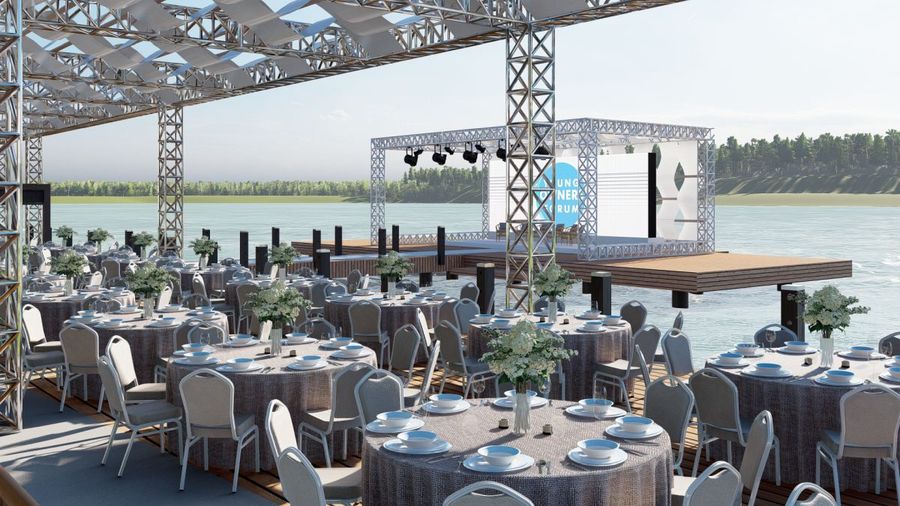 Waterfront event build with a truss canopy, round banquet tables and a stage on the shoreline — BACKSTAGE Event design visualisation (design image, not a photograph)
Waterfront terraces and restaurant venues
These sit a step below the yalıs in price and formality. Many are on the Asian shore, where the view faces the historic peninsula and the sunset lands behind your guests rather than in their eyes — a small thing that matters enormously in photographs.
Open shoreline grounds
Empty plots and quays that you build from nothing. The Istanbul-specific questions are access ones: can a truck reach the shoreline, is there a quay to load in by boat, and who issues the permit for a private stretch of waterfront. What you buy is total control of the layout — section 7 covers what it costs.
One constant across all three: wind. The Bosphorus funnels it between two seas, and the two that matter have names — the northerly poyraz and the southwesterly lodos. Which one is blowing decides which shore is sheltered, so a date can be calm on one side of the strait and unworkable on the other. Ask the venue which wind its terrace faces. (The engineering side — wind loads, ballast, when structures come down — is in our destination wedding guide.)
3. Historic Venues: Palaces, Mansions and Courtyards
Istanbul has former palaces, pavilions, caravanserais and restored mansions that host weddings, most of them managed by public bodies or foundations rather than commercial operators.
The appeal is obvious. The trade-offs are less so:
- Applications run on their own calendar. Formal applications months ahead, fixed forms, fixed answers. Not a place for a late decision.
- Conservation rules bind the build. Nothing may be fixed to the historic fabric, open flame is limited, and amplified sound often has a hard curfew.
- Catering may be tied. Some heritage sites work with an approved caterer list, which limits menu flexibility.
For a ceremony that should feel like the city's history rather than its skyline, nothing else comes close. Just budget three extra months of lead time and accept that the venue sets the rules.
4. Hotel Ballrooms and Five-Star Grounds
For most international couples, a hotel is the practical answer — not because the room is more beautiful, but because it removes six problems at once: guest rooms, catering, kitchen infrastructure, parking, contingency space for rain, and a single contract instead of a dozen.
Istanbul's five-star hotel venues divide into four rough types:
- Bosphorus-front hotels — terrace ceremony, ballroom reception, the view included. The most expensive category, and the one that books first.
- Historic-property hotels — restored palaces and mansions run as hotels, combining heritage rooms with hotel service.
- City-centre business hotels — the largest ballrooms in the city, 500 to 1,000+ guests, strong on logistics and weak on romance. For very large weddings they are often the only option.
- Airport and outer-district hotels — the value tier, and genuinely sensible when most guests fly in and out within 48 hours.
We deliberately do not rank hotel brands here. Ownership and banquet teams change, and a ballroom that ran flawlessly two years ago may be under a different operator today — the useful question is which team is running your week, not which sign is on the building. If your guests need a room block alongside the venue, our hotel accommodation service handles that side as one negotiation rather than two.
5. Boat Weddings on the Bosphorus
A boat wedding solves something no fixed venue can: the view changes. You board at sunset, sail past the palaces and bridges while dinner is served, and the city rotates around your guests all evening.
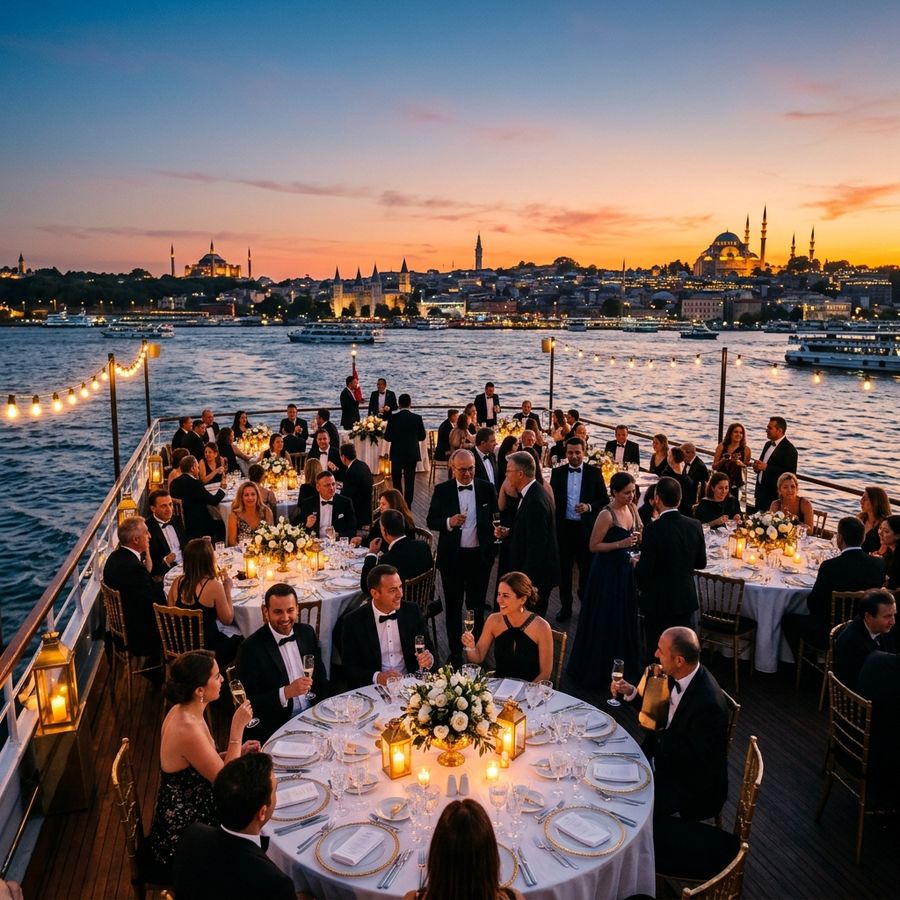 Evening reception on a boat deck on the Bosphorus with candlelit round tables and the Istanbul skyline at sunset
What to know before you commit:
- Capacity is the hard limit. Private yachts take 20 to 80 guests, mid-size vessels 100 to 200, and the largest charters 300 to 500 — though most couples land between 40 and 150, the range a Bosphorus evening suits best. The number on the licence is not negotiable, and unlike a garden you cannot add a row of chairs.
- The legal ceremony depends on the municipality. Turkish civil marriage is performed by a municipal registrar. Whether the registrar will officiate on board is the municipality's decision, and it has to be reserved early. Otherwise the on-board ceremony is symbolic and the civil formality is completed ashore beforehand. The process is set out in the destination wedding guide.
- Cost sits mid-range, not low. As an indicative 2026 band, a full-evening private charter with catering runs from roughly €120 to €300 per guest depending on vessel and menu. Prices are quoted in Turkish lira and move with the exchange rate.
- Weather has no plan B. A boat cannot be tented. Build a shore-side fallback into the contract, and be honest that a rough Bosphorus in a strong southwesterly is uncomfortable for older guests.
Boarding logistics deserve a mention: guests arrive at a quay, not a car park, and a coordinated arrival window is essential. This is exactly what our VIP transfer and logistics management exists for.
6. Gardens, Rooftops and Modern Event Spaces
Away from the water and the heritage list, Istanbul has three growing categories.
Garden venues and country estates
On the city's northern edge and along the Belgrade Forest, these give you lawn, trees and space to build — the closest thing to a countryside wedding within reach of the city. They suit informal daytime ceremonies and long dinners, and they take marquees well.
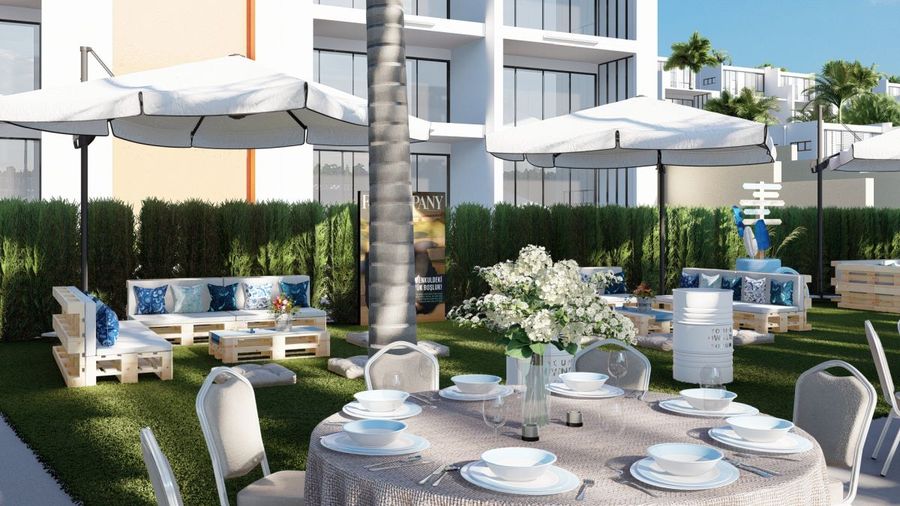 Garden reception setup with white parasols, lounge seating and a floral banquet table on a lawn — BACKSTAGE Event design visualisation (design image, not a photograph)
Rooftops
The compact option: 60 to 150 guests, a skyline instead of a garden, and a lift as your only load-in route. That last point drives the whole production plan — everything has to fit in a service lift, which rules out large staging.
Converted industrial spaces
Former workshops, warehouses and shipyard halls along the Golden Horn are the blank-canvas venues: industrial volume, no built-in charm, total design freedom. They are also where lighting and staging make or break the evening — stage production takes a bigger share of the budget here than in any other venue type. The same crews work the city's festival season, mapped out in our festival guide for Istanbul and Turkey.
Wedding halls: the local market
Istanbul has a large market of dedicated wedding halls serving local families — typically all-inclusive, priced per person and booked on a much shorter lead time than anything above. An Istanbul wedding hall is rarely what an international couple pictures, but for a large guest list on a controlled budget it is worth a look, and the better ones handle 500 guests without blinking.
Couples planning a coastal wedding rather than a city one should look outside Istanbul entirely — Ölüdeniz, Bodrum and the Antalya coast are a different decision, covered in our beach wedding in Turkey guide.
7. Matching the Venue to Your Guest Count and Budget
Guest count filters the list faster than budget does. Work in this order.
| Guests | Realistic venue types |
|---|---|
| Up to 80 | Private yacht · rooftop · small yalı garden · restaurant terrace |
| 80–200 | Yalı · historic mansion · garden estate · larger rooftop · mid-size charter · most hotel ballrooms |
| 200–400 | Large hotel ballroom · waterfront grounds · charter vessel · industrial space · wedding hall |
| 400+ | City-centre hotel ballrooms · wedding halls · large charter vessel · built event grounds |
On budget, one number is worth internalising: the venue fee usually lands under a third of the total. Waterfront and heritage venues sit at the top of the market, garden and hotel venues below them, and the rest of the spend follows catering standard, floral volume and production scale rather than the venue itself.
Two costs are consistently underestimated. Build-heavy venues — empty grounds, industrial halls, private plots — carry an infrastructure bill (power, flooring, kitchen, sanitary) that a hotel absorbs invisibly. And peak-date premiums on Saturdays in June and September are real: moving to a Friday in the same week can change the quote noticeably without changing anything your guests experience.
8. Practical Checks Before You Book
Before signing, walk the venue with this list.
Sound curfew
Ask for the hour amplified music must stop, in writing. Venues near housing on the Bosphorus and in historic districts often stop between 23:00 and 00:00 — not a negotiation you want to open at midnight.
Wind and weather
For any outdoor build: what is the covered fallback, who decides, and by when? A wet-weather call made at 14:00 is a plan; one made at 18:00 is a crisis.
Load-in reality
Truck access, lift dimensions, how far equipment travels by hand, what time the crew may start. Historic and rooftop venues frequently allow build only on the event day itself, which compresses everything.
Power
Ask for available amperage and whether a generator is permitted — lighting, sound and catering together draw far more than most venues' house supply.
Photography timing
Sunset shifts by roughly an hour and a half between the June peak and early October, and the golden-hour window on the Bosphorus is short. Set the ceremony hour around the light, not the other way round — our overseas wedding photography guide goes into how that planning works in practice.
A single point of accountability
The most common failure in a destination wedding is not a bad venue; it is a dozen suppliers with no one holding the schedule. Whether that is a planner, a DMC or the hotel's banquet manager, one person must own the day.
Planning a Wedding in Istanbul
We produce weddings, galas and large-format events in this city — venue sourcing, contracting, production and the run of the day. You can see the scale of what we build in our project portfolio, where a corporate New Year party runs on the same production discipline as a 300-guest wedding, just with a different guest list. There is more on our wedding and gala management service, and the weddings section has the full picture.
If you have a date and a rough guest count, that is enough to start a shortlist. Get in touch and we will come back with venue options that actually fit the brief.
Frequently Asked Questions
What are the best wedding places in Istanbul?+
It depends on your guest count. Bosphorus yalıs — the wooden waterfront mansions — and shoreline terraces suit 150–250 guests and carry the view everyone comes for; historic palaces and courtyards suit formal ceremonies under conservation rules; hotel ballrooms handle 400 and above. Boats, rooftops and garden estates cover the smaller and more informal end.
How much does a boat wedding on the Bosphorus cost?+
As an indicative 2026 band, a full-evening private charter with catering runs from roughly €120 to €300 per guest. Prices are quoted in Turkish lira and move with the exchange rate. Capacity is fixed by the vessel licence — yachts take 20–80 guests and the largest charters 300–500, though most weddings land between 40 and 150.
How many guests can Istanbul wedding venues hold?+
Most romantic venues are smaller than couples expect. Historic mansions and shoreline properties seat 120–300; rooftops 60–150; private yachts up to 80. Above 400 guests your realistic options narrow to city-centre hotel ballrooms, dedicated wedding halls and built event grounds.
When is the best time of year for a wedding in Istanbul?+
June and September are the two best months — mild evenings, long light and low rain risk — and the best waterfront dates in them go twelve to eighteen months ahead. Outdoor season runs May to early October; July and August need an evening start. November to April is an indoor season.
Can foreign couples marry legally in Istanbul?+
Yes. The legal marriage is performed by a municipal registrar with translated and apostilled documents. Some municipalities will send the registrar to your venue, which has to be reserved early; otherwise the ceremony at your venue is symbolic and the civil formality is completed beforehand. The document list and timings are set out in our destination wedding in Turkey guide.
Subscribe to Our Newsletter
Subscribe to our newsletter for event trends, design insights, and exclusive content.


