


BACKSTAGE Event
BACKSTAGE Event is an Istanbul-based corporate event and MICE organization company. Our expert team specializes in congresses, conferences, product launches, and gala events, bringing every project from backstage to the stage.

You have decided to marry somewhere that is not home. Somewhere your guests will remember, somewhere the photographs will not look like everyone else's, somewhere the budget stretches further than it would in Tuscany or the South of France. Turkey keeps appearing on your shortlist — and then the questions start. Can foreigners legally marry here? What does it actually cost? Is Istanbul the right choice, or should it be the coast? How do you plan a three-day celebration in a country you have visited twice?
This guide answers those questions in order. It is written for couples planning from abroad — from the UK, Germany, the Gulf, India, the United States — and for the families and planners supporting them. Everything below reflects how weddings are actually delivered in Turkey in 2026: real paperwork, real venue types, real budget bands, and the production detail that separates a smooth celebration from an expensive improvisation.
Last updated: July 2026
Table of Contents
- Why Couples Choose Turkey
- Legal Requirements for Foreign Couples
- Choosing Your Region
- Venue Types and What They Really Cost You
- Budget Planning: Indicative 2026 Figures
- The 12-Month Planning Timeline
- Guest Logistics: Visas, Flights, Transfers, Hotels
- Production: Stage, Light, Sound and Decor
- Multi-Day and Culture-Specific Weddings
- Choosing a Planner or DMC in Turkey
1. Why Couples Choose Turkey
Three reasons come up again and again, and they are worth separating because they matter differently depending on your guest list.
Cost per guest, not cost per photograph
A destination wedding in Turkey typically costs 40–60% less than an equivalent wedding in Italy, France or Spain — same guest count, same service level, same production quality. The gap is not down to cutting corners. It comes from local supply: florists, catering kitchens, furniture rental, staging companies and technical crews all operate at Turkish cost levels while working to international standards, because they serve a large domestic corporate events market year-round.
What this means in practice: the budget that buys you 60 guests in Puglia buys you 100 in Bodrum, or 60 guests with a live band, a second-day beach party and full production instead of a DJ and rented speakers.
Reachability
Istanbul Airport connects to more countries than any other airport in the world, and Turkish Airlines flies direct from over 130 countries. For a wedding where guests fly in from three continents — a common scenario for Indian, Gulf and diaspora families — this is not a detail. It is the difference between everyone arriving on a Thursday evening and half the party losing a day to connections in Doha or Frankfurt.
Domestic connections matter too. Bodrum, Dalaman, Antalya and Kayseri (for Cappadocia) all take under 90 minutes from Istanbul, with frequent daily flights.
Scenery that does not repeat itself
Within a two-hour domestic flight you can choose between a 19th-century Ottoman mansion on the Bosphorus, a cliff-edge terrace over the Aegean, a cave hotel in Cappadocia with hot-air balloons at sunrise, or a pine-backed beach in Kaş. Few destinations offer that range without a long transfer between them.
The honest limitations
Turkey is not the right answer for everyone, and a planner who tells you otherwise is selling rather than advising:
- Alcohol regulations vary by venue and municipality. Most licensed venues serve without restriction, but some municipal and religious sites do not permit alcohol at all. This needs confirming before you fall in love with a location.
- July and August on the coast are genuinely hot — 33–38°C is normal. Outdoor ceremonies before 18:00 in high summer are uncomfortable for guests in formal dress.
- Public holidays move. Religious holiday weeks (Ramazan Bayramı and Kurban Bayramı) shift roughly 11 days earlier each year, and during them domestic flights, hotels and staff availability all tighten. In 2026 this affects mid-March and late May.
2. Legal Requirements for Foreign Couples
This is the section couples worry about most and it is more straightforward than expected — provided you start early. Two foreign nationals can legally marry in Turkey, and the marriage is recognised internationally once properly registered and apostilled.
How the legal marriage works
Civil marriage in Turkey is performed by an authorised marriage officer at a municipality (belediye) marriage office. Religious ceremonies — including the Islamic nikah — have no legal standing on their own and by law must follow the civil ceremony, not replace it. In practice, most international couples do the civil formality quietly and then hold the celebration they actually care about at their chosen venue.
Some municipalities will send an officer to an external venue so the legal ceremony happens in front of your guests. Availability differs by district and needs booking well in advance.
Documents typically required
Requirements are set nationally but applied by the local municipality, and small differences between districts are normal. Expect to provide:
| Document | Notes |
|---|---|
| Valid passports | Plus photocopies of the photo page |
| Birth certificates | Apostilled and translated into Turkish by a sworn translator |
| Certificate of no impediment | Also called a certificate of capacity to marry, issued by your home country or your embassy in Turkey |
| Proof of divorce or death certificate | If either party was previously married |
| Health report | Obtained locally from a state or authorised private hospital |
| Passport photographs | Usually six per person |
Two rules cause almost all the delays we see:
- Apostille first, then translate. Foreign documents need an apostille from the issuing country before they are translated by a sworn translator in Turkey and notarised. Doing it in the wrong order means starting again.
- Watch the validity window. Health reports and certificates of no impediment are typically only accepted within a limited period after issue — often around six months, shorter for the health report. Getting them too early is as much of a problem as getting them too late.
Practical advice: confirm your exact document list with the specific municipality where you intend to register, and with your own embassy in Ankara or consulate in Istanbul, at least four months before the date. Requirements are stable but not identical everywhere, and this guide is not a substitute for that confirmation.
The alternative most international couples choose
A large share of foreign couples complete the legal marriage at home — a short registry appointment weeks or months earlier — and treat the Turkish event purely as the celebration. That removes the paperwork from the critical path entirely and lets you design the ceremony around meaning rather than around a marriage officer's schedule. If your guest list is large and international, this is usually the lower-stress route.
3. Choosing Your Region
Region determines more than scenery. It sets your transfer times, your supplier depth, your weather risk and a meaningful part of your budget.
Istanbul
Best for: city weddings, historic venues, large multi-day events, guests arriving from many countries.
Istanbul offers restored Ottoman yalı mansions directly on the Bosphorus, palace-era venues, rooftop terraces over the old city, and five-star hotel ballrooms capable of 500+ guests — covered venue by venue in our Istanbul wedding venues guide. It has by far the deepest supplier base in the country — the same florists, technical crews and catering kitchens that serve corporate events for global brands work weddings.
The trade-off is traffic. A 12-kilometre transfer between hotel and venue can take 20 minutes or 70 depending on the hour, and a Saturday-evening Bosphorus wedding sits squarely in the worst of it. This is solvable with sequenced coach departures and, for the couple, a boat transfer — but it must be planned, not assumed.
Bodrum and Çeşme
Best for: two-to-three-day summer celebrations, beach club energy, 60–200 guests.
The Aegean coast is where most international destination weddings in Turkey actually happen. Bodrum in particular has a cluster of venues built specifically for this: cliffside terraces, private beaches, hotels with dedicated wedding lawns. Suppliers are experienced with foreign couples and English is widely spoken.
Book early. The window between mid-June and early September is genuinely competitive, and the best venues are taken 12–18 months ahead.
Antalya, Kaş and Kalkan
Best for: value, warm sea, longer seasons, larger guest counts on a controlled budget.
The Mediterranean coast runs a longer season — comfortable weddings from late April through October — and hotel capacity is enormous, which keeps accommodation costs down. Kaş and Kalkan offer a more intimate, low-rise character; Antalya proper is better suited to large resort-based weddings.
Cappadocia
Best for: small, visually extraordinary weddings, 20–80 guests.
Cave hotels, valley terraces, and hot-air balloons at sunrise. Nothing else in Turkey photographs like it. The constraints are real, though: venue capacities are small, luxury accommodation is limited, and everything — flowers, staging, specialist equipment — travels in from Ankara or Istanbul, which shows up in the budget.
Season at a glance
| Period | Coast | Istanbul | Cappadocia |
|---|---|---|---|
| April – mid May | Cool sea, low prices | Excellent, occasional rain | Excellent |
| Mid May – June | Ideal | Ideal | Ideal |
| July – August | Hot; evening events only | Hot and humid | Hot days, cool nights |
| September – mid October | Ideal, warm sea | Ideal | Ideal |
| Late October – March | Off-season, limited venues | Indoor venues only | Cold, sometimes snow |
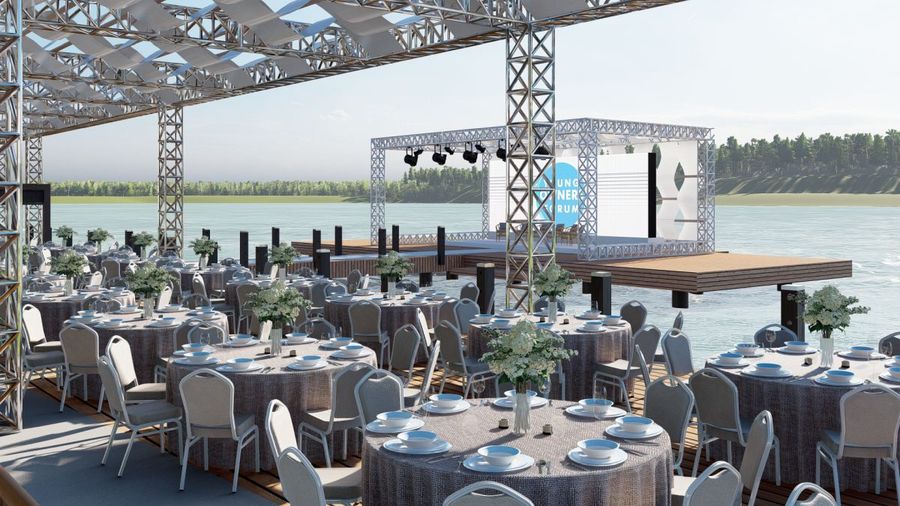 Waterfront reception design for a destination wedding — round tables and a covered dining terrace over the water, BACKSTAGE Event design visualisation
4. Venue Types and What They Really Cost You
The published venue fee is rarely the number that matters. What matters is what the fee includes and what it forces you to bring in.
Hotel and resort venues
Typical structure: per-person package covering food, standard beverage, basic furniture and service staff.
The most predictable option, and the easiest if most of your guests are staying on site. Look carefully at what "package" means: the difference between the base menu and what you actually want served is often 30–40% per head. Ask specifically about corkage if you want particular wines, and about whether the package price holds if your final count drops.
Private villas and estates
Typical structure: venue rental only. Everything else is yours to arrange.
Beautiful, exclusive, and the option most likely to blow a budget quietly. A bare estate needs kitchens (or a full mobile kitchen), generators, toilets, furniture, lighting, staff transport and often a noise-permitted licence. None of that is expensive on its own; together it can equal the venue fee.
Historic and heritage venues
Typical structure: rental plus approved-supplier list, plus conservation restrictions.
Ottoman mansions, old customs buildings, restored industrial spaces. The restrictions matter more than couples expect. Protected structures frequently prohibit rigging from ceilings or walls, which means every light and every hanging installation must be ground-supported on towers or truss — a real cost and a real design constraint. Confirm rigging rules before, not after, you approve a design.
Beach and open-air venues
Typical structure: rental, with almost everything brought in.
Sand does not support standard staging without load-spreading. Sea breeze that feels pleasant at 18:00 regularly reaches 30–40 km/h by 21:00, which is enough to take down an under-ballasted structure or ruin a tall floral installation. Any open-air build needs a documented wind-load plan and a stated threshold at which elements come down — and a covered wet-weather alternative that is booked, not theoretical.
Boats and Bosphorus cruises
Typical structure: per-boat charter, hourly.
Genuinely special for 40–150 guests, and self-solving for transfers. Limitations: fixed timings, restricted power for large sound and lighting, weather cancellation risk, and no realistic way for a guest to leave early.
5. Budget Planning: Indicative 2026 Figures
The bands below reflect what internationally-hosted weddings in Turkey are costing in 2026, at good-to-excellent service level, with production, catering, flowers, coordination and technical crew included. They exclude flights, guest accommodation, and the couple's own attire.
| Wedding profile | Guests | Indicative total (EUR) | Per guest |
|---|---|---|---|
| Intimate ceremony and dinner | 25–50 | €18,000 – €40,000 | €600 – €900 |
| Single-day celebration, full production | 80–120 | €45,000 – €95,000 | €500 – €800 |
| Two-day celebration, coast or Istanbul | 120–200 | €90,000 – €180,000 | €650 – €950 |
| Multi-day, high-production, culture-specific | 250–400 | €200,000 – €500,000+ | €800 – €1,400 |
Where the money actually goes
For a typical 120-guest single-day wedding, the split looks roughly like this:
| Category | Share of budget |
|---|---|
| Food and beverage | 35–45% |
| Venue rental | 10–20% |
| Production: stage, lighting, sound, power | 12–18% |
| Flowers and decor | 10–15% |
| Photography and video | 6–10% |
| Music and entertainment | 5–10% |
| Planning and coordination | 8–12% |
| Contingency | 5–10% |
The four costs that surprise people
- Currency exposure. Between signing and settling, exchange rates move. Agree in writing which currency each contract is denominated in and whether the price is fixed or indexed. This single clause has cost couples more than any other.
- Wet-weather cover. A tent or marquee capable of covering 150 guests to a standard you would be happy with is not a small line item, and booking it late costs considerably more than booking it with everything else.
- Guest count drift. International guest lists move late. Most catering contracts fix the minimum guaranteed number 7–14 days out; understand that date and what happens on either side of it.
- Overtime. Crew, venue and sometimes music all have contracted end times. Weddings run long. Agree overtime rates in advance rather than at 01:30.
Ask every supplier the same question: what is not included in this price? A quote that answers it clearly is worth more than a quote that is 10% cheaper.
For line-by-line prices by region, from per-guest menus and venue hire to registry fees and three sample budgets, see our wedding in Turkey cost guide.
6. The 12-Month Planning Timeline
Destination weddings fail on sequence, not on effort. This is the order that works.
12–10 months out
- Fix the region, the approximate date and the realistic guest count. Everything else depends on these three.
- Appoint your planner or DMC. Do this before venue selection, not after — a good planner will steer you away from venues that cannot deliver what you want.
- Shortlist and visit venues, or commission a proper video walkthrough if you cannot travel.
- Sign the venue and secure a room block at your primary hotel.
9–7 months out
- Send save-the-dates. For a destination wedding this is not optional — guests need lead time to book flights and leave.
- Contract the core suppliers: catering, production, photography, music.
- Begin the legal documentation process if you are marrying in Turkey. Start with your own embassy.
- Confirm the wet-weather plan and put it in writing.
6–4 months out
- Menu tasting and final food and beverage design.
- Approve the production design: stage, lighting plan, decor, floor layout. If the venue restricts rigging, this is when that constraint gets designed around.
- Build the guest transport plan — arrival waves, coach schedules, VIP transfers.
- Confirm entertainment and any special performances.
3–2 months out
- Formal invitations and RSVP tracking.
- Guest visa checks. Identify anyone who will need a consulate appointment rather than an e-Visa, and tell them early.
- Detailed run-of-show, minute by minute, shared with every supplier.
- Site technical visit with the production team.
Final month
- Final guest numbers to catering, with the seating plan.
- Rehearsal, plus a technical rehearsal for sound, light and any recorded content.
- Payment schedule completed; confirm who settles what on the day.
- Weather monitoring and the trigger point for switching to the covered plan.
7. Guest Logistics: Visas, Flights, Transfers, Hotels
For most couples this is the part that consumes the most attention in the final two months, and the part guests judge you on.
Visas
Turkey operates an electronic visa system covering many nationalities, alongside visa-free access for others and consulate applications for the rest. Two points matter for wedding planning:
- Some nationalities qualify for the e-Visa only conditionally — for example, holding a valid Schengen, UK, US or Irish visa or residence permit. This affects a meaningful share of guests on Indian and some other passports, and it is the single most common cause of a guest missing a destination wedding.
- Consulate appointments take time. Where a guest needs a sticker visa rather than an e-Visa, appointment availability, not processing, is usually the bottleneck.
Check the current rules on the official e-Visa portal for each nationality on your list, and do it at the invitation stage rather than a month out. Where guests need supporting documentation, a formal invitation letter naming the event, the venue and the dates helps.
Flights and arrival waves
Guests will not all arrive together. Group them into waves — typically an early wave of family two or three days ahead, a main wave the day before, and a late wave arriving the morning of. Each wave needs its own transfer arrangement. Trying to handle 40 separate arrivals individually is how airport pickups go wrong.
Where guest numbers justify it, airlines will discuss group fares. Ask.
Accommodation
Block-book across two or three properties at different price points rather than one. Guests have different budgets and forcing everyone into a five-star resort quietly reduces your attendance. Keep the properties close enough that one coach route serves them all.
Our hotel accommodation coordination works exactly this way — negotiated block rates across tiers, with a single rooming list rather than 60 individual reservations to chase.
Ground transport
Build the transfer plan around the schedule, not the other way around. Practical rules:
- Coaches for the main movements, minibuses for small groups, dedicated cars for the couple and immediate family.
- Add 40% to any Istanbul transfer estimate for a Friday or Saturday evening.
- Have a named person on each coach with the guest list and a phone.
- Plan the return as carefully as the arrival — the end of the night is when transport most often falls apart.
For weddings where senior family or VIP guests need discreet, reliable handling, VIP transfer and logistics management covers meet-and-greet at the airport through to the final departure.
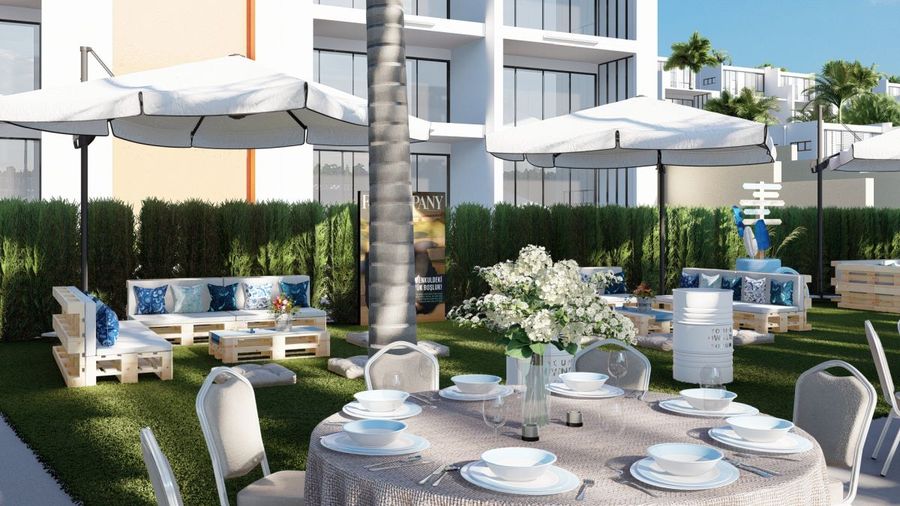 Open-air dining setup with white parasols and a dressed table on a garden terrace — destination wedding design visualisation, BACKSTAGE Event
8. Production: Stage, Light, Sound and Decor
This is the difference between a wedding that looks like the mood board and one that does not. It is also the area where couples planning from abroad have the least visibility, because you cannot inspect a lighting plan over email.
Lighting is the whole atmosphere
Daylight ceremonies need almost nothing. Everything after sunset is lighting. The three layers that matter:
- Functional light — paths, steps, the bar, the toilets. Guests should never be navigating in the dark.
- Atmospheric light — warm uplighting on walls and trees, festoon overhead, candlelight on tables. This is what makes photographs look like the ones you saved.
- Focus light — the ceremony point, the first dance, the cake. Small, precise, and the reason the key photographs work.
A frequent mistake is over-lighting the dinner. Dinner should sit around 2700K and low; the space should feel like candles, not like a conference room.
Sound scales with the space
An open-air venue with 150 guests and a live band needs real speaker coverage and someone competent mixing it. A single pair of speakers next to the stage means the front tables cannot hear each other and the back tables cannot hear the band. Ask any production supplier how they intend to cover the space, and be sceptical of an answer that does not involve distributed speakers.
Speeches deserve their own attention. Two wireless microphones and a technician who checks them beforehand prevents the single most common wedding-video failure.
Power
Villas and beaches do not have the power for a full production. That means generators — sized properly, placed far enough away to be inaudible, and with a redundant unit for anything critical. A generator that trips during the first dance is a very expensive way to learn this.
Structures and weather
Anything built outdoors — arches, mandaps, floral installations, tented structures — needs ballast or ground anchoring appropriate to the site and a stated wind threshold. Our production teams work to the same standards on weddings as on open-air brand events, because the physics does not care what the occasion is.
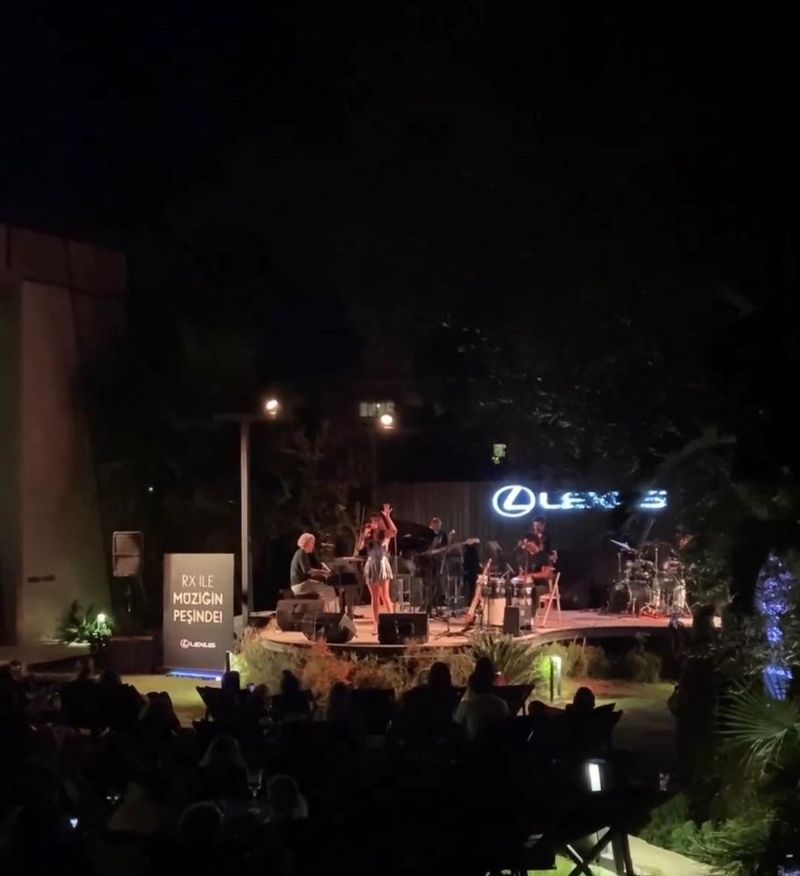 Live band on an open-air stage at night with full lighting rig and audience seating — BACKSTAGE Event open-air production, Istanbul
9. Multi-Day and Culture-Specific Weddings
Turkey handles multi-day and religiously specific weddings well, largely because the domestic market already runs three-day celebrations as standard.
Indian weddings
Turkey has become a serious contender for Indian destination weddings, and the reasons are practical: direct flights from Delhi and Mumbai to Istanbul, venue costs well below Europe, and a hospitality industry accustomed to large, multi-day, family-centred events.
What a properly planned Indian wedding in Turkey requires:
- Genuine multi-day venue holds. Mehendi, Sangeet, the wedding day and often a reception — that is three to four days of the same venue or a coordinated set of venues, not a single-day booking extended.
- Catering that is actually credible. This means either a specialist Indian catering team brought in, or a hotel kitchen working with an Indian chef. Pure vegetarian and Jain requirements need separate preparation areas, and this must be agreed in the contract, not discussed on the day.
- Mandap and ceremonial structures. Built to design, ground-supported where rigging is restricted, and with the sacred fire (havan) cleared with the venue and local fire authority in advance. Some heritage and indoor venues will not permit open flame at all.
- Baraat route planning. A procession with music, sometimes with a horse, needs a route, a permit where public roads are involved, and a realistic assessment of whether the venue's approach can accommodate it.
- Guest volume. 250–400 guests across four days is a logistics operation, not a wedding booking. Room blocks, coach fleets and meal service at that scale need the same planning discipline as a corporate congress.
Muslim ceremonies
The religious nikah can be performed at the venue by an authorised imam, following the civil ceremony. Halal catering is straightforward everywhere in Turkey and requires no special arrangement. Where a couple wants alcohol served alongside a religious ceremony, discuss it with the venue early — most licensed venues accommodate this without issue, but not all.
Christian and Jewish ceremonies
Both are entirely possible. Istanbul has active historic churches and synagogues, several of which host ceremonies, though most require advance arrangement with the congregation and some restrict to members. Symbolic ceremonies conducted by a visiting officiant at your venue are the more common route and carry no restrictions.
Same-sex couples
Turkey does not recognise same-sex marriage, so there is no legal ceremony available. Symbolic celebrations do take place, and private venues host them, but this needs handling with a planner who will be honest with you about individual venue attitudes rather than optimistic.
10. Choosing a Planner or DMC in Turkey
You are hiring someone to spend a significant amount of your money in a country whose language you probably do not speak, using suppliers you cannot check. The selection deserves more rigour than most couples give it.
Questions worth asking
- Are you a planner, a venue agent, or a DMC? These are different businesses. A venue agent earns commission on the venue. A DMC (destination management company) holds supplier relationships and takes operational responsibility. Know which one you are talking to.
- Who is on site on the day, and what else are they running that weekend? The answer should be a named person, and the second half of the answer should be "nothing".
- How do you handle payments to suppliers? You want a clear structure, in writing, with a schedule — not a series of transfers on request.
- What happens if it rains? A good answer is specific and already costed. A vague answer means there is no plan.
- Can I speak to a couple you worked with last season? Not a testimonial on a website. An actual conversation.
- What is your production capability — owned or subcontracted? A company with its own technical crew and equipment controls quality and cost. A company subcontracting everything adds a margin and loses control on the day.
Why production experience matters more than it sounds
The suppliers who deliver corporate events at scale — congresses, brand launches, festival stages — solve harder technical problems weekly than a typical wedding presents. Load calculations, power planning, wind thresholds, sequenced logistics for hundreds of people: that is routine work on a corporate event and it is exactly what an outdoor wedding for 200 guests actually requires.
At BACKSTAGE Event we run both. The same crews who build stages for automotive launches and international summits handle our luxury wedding and gala management work, which is why we plan a beach ceremony with a wind threshold and a documented contingency rather than a hope that the weather holds.
Starting Your Own Planning
If you have read this far, you are past the inspiration stage and into the practical one. The useful next steps are narrow: fix your region, fix your approximate date, get a realistic guest count, and then talk to someone who can tell you what that combination actually costs before you fall in love with a venue.
Look through our portfolio to see how we build and light events at this scale, read more about our approach on the destination weddings page, or get in touch with your dates and guest numbers and we will come back with a realistic budget range rather than a brochure.
💡 Related reading: Corporate Event Planning: The Complete 2026 Guide covers the planning discipline behind large-scale events, and Congress Organization in Istanbul goes deeper on managing international guest logistics at volume.
Frequently Asked Questions
Can two foreign nationals legally get married in Turkey?+
Yes. Civil marriage is performed by an authorised marriage officer at a municipality marriage office, and the marriage is recognised internationally once registered and apostilled. You will typically need passports, apostilled and translated birth certificates, a certificate of no impediment from your home country or embassy, a locally obtained health report and passport photographs. Apostille the documents in the issuing country first, then have them translated by a sworn translator in Turkey — doing it in the reverse order means starting again. Confirm the exact list with the specific municipality and your own embassy at least four months ahead. Many international couples instead complete the legal marriage at home and treat the Turkish event purely as the celebration.
How much does a destination wedding in Turkey cost in 2026?+
As an indication, at good-to-excellent service level including production, catering, flowers and coordination: an intimate ceremony and dinner for 25–50 guests runs about €18,000–40,000; a full single-day celebration for 80–120 guests about €45,000–95,000; a two-day celebration for 120–200 guests about €90,000–180,000; and a multi-day, high-production or culture-specific wedding for 250–400 guests from €200,000 upwards. These figures exclude flights, guest accommodation and attire. Overall this is typically 40–60% below an equivalent wedding in Italy, France or Spain, because local suppliers work to international standards at Turkish cost levels.
When is the best time of year to get married in Turkey?+
Mid-May to June and September to mid-October are ideal everywhere — coast, Istanbul and Cappadocia alike. July and August on the coast are genuinely hot at 33–38°C, which makes outdoor ceremonies before 18:00 uncomfortable for guests in formal dress; evening events work well. April to mid-May is cooler and cheaper with some rain risk. From late October to March the coast is largely out of season and Istanbul is limited to indoor venues. One planning trap: the religious holiday weeks move roughly 11 days earlier each year and tighten domestic flights, hotels and staff availability — in 2026 that means mid-March and late May.
Will our guests need a visa to attend a wedding in Turkey?+
It depends on nationality. Turkey operates an electronic visa system for many nationalities, visa-free entry for others, and consulate applications for the rest. The detail that catches wedding parties out is that some nationalities qualify for the e-Visa only conditionally — for example while holding a valid Schengen, UK, US or Irish visa or residence permit. This affects a meaningful share of guests travelling on Indian and certain other passports, and it is the single most common reason a guest misses a destination wedding. Check the current rules on the official e-Visa portal for every nationality on your list at the invitation stage, not a month out, and issue a formal invitation letter naming the event, venue and dates for anyone who needs supporting documents.
Can we hold a multi-day Indian wedding in Turkey?+
Yes, and it is one of the fastest-growing reasons couples choose Turkey: direct flights from Delhi and Mumbai to Istanbul, venue costs well below Europe, and a hospitality industry already used to three-day celebrations. Planning it properly means booking genuine multi-day venue holds for Mehendi, Sangeet, the wedding day and reception rather than extending a single-day booking; agreeing pure vegetarian and Jain preparation areas in the catering contract, not on the day; building the mandap to design with ground support where rigging is restricted; clearing the sacred fire with the venue and local fire authority in advance, since some heritage and indoor venues do not permit open flame; and planning the baraat route with a permit where public roads are involved. At 250–400 guests over four days this is a logistics operation and needs the same planning discipline as a corporate congress.
Subscribe to Our Newsletter
Subscribe to our newsletter for event trends, design insights, and exclusive content.


