


BACKSTAGE Event
BACKSTAGE Event is an Istanbul-based corporate event and MICE organization company. Our expert team specializes in congresses, conferences, product launches, and gala events, bringing every project from backstage to the stage.

Corporate event planning is the art of transforming a brand's vision into a live, immersive experience. Whether it's a product launch in Istanbul, an international congress, a dealer meeting, or a prestigious gala dinner — every event has the potential to become unforgettable with the right planning. However, successful corporate event management demands far more than booking a venue: it requires strategic thinking, meticulous coordination, creative design, and flawless execution working in harmony.
In this guide, we walk you through every stage of the corporate event planning process — from budgeting and venue selection to stage design, logistics, and technology integration — with a professional perspective shaped by years of experience producing events across Turkey and beyond. Whether you're organizing your first large-scale corporate event or looking to elevate your next one, this 2026 guide is built for you.
Table of Contents
- Define Your Event Objectives
- Budget Planning: Realistic and Detailed
- Choosing the Right Venue
- Stage Design and Technical Production
- Logistics Management and Attendee Experience
- Digital Integration and Hybrid Events
- Post-Event: Measurement and Evaluation
- Corporate Event Trends Shaping 2026
1. Define Your Event Objectives
Every successful corporate event begins with a crystal-clear set of objectives. The answer to "Why are we doing this event?" becomes your compass for every decision that follows — from venue selection to speaker lineup, from budget allocation to content strategy.
The SMART Goal Framework
Define your objectives using the SMART methodology:
- Specific: Instead of "increase brand awareness," aim for "reach 500 decision-makers in our target industry"
- Measurable: Set concrete KPIs such as attendee count, media reach, lead generation, or sales conversion rate
- Achievable: Align goals with your available budget and resources
- Relevant: Ensure the event supports your company's broader business strategy
- Time-bound: Create clear timelines for pre-event, during, and post-event milestones
Objective Examples by Event Type
| Event Type | Primary Objective | Key Metric |
|---|---|---|
| Product Launch | Introduce a new product to market | Media coverage, social shares, lead capture |
| Congress / Summit | Establish thought leadership | Attendee count, speaker caliber, sponsor ROI |
| Dealer Meeting | Drive sales motivation and alignment | Sales commitment targets, satisfaction scores |
| Gala Dinner | Elevate brand prestige | VIP attendance rate, press coverage |
| Training Seminar | Facilitate knowledge transfer | Participant satisfaction, post-training assessments |
Once your objectives are defined, share them with every stakeholder — from your internal team to your event management partner. Alignment from day one prevents costly misalignment down the road.
2. Budget Planning: Realistic and Detailed
Budget management is one of the most critical steps in the corporate event planning process. A well-structured budget not only keeps expectations in check but also ensures every dollar is spent where it creates the most impact.
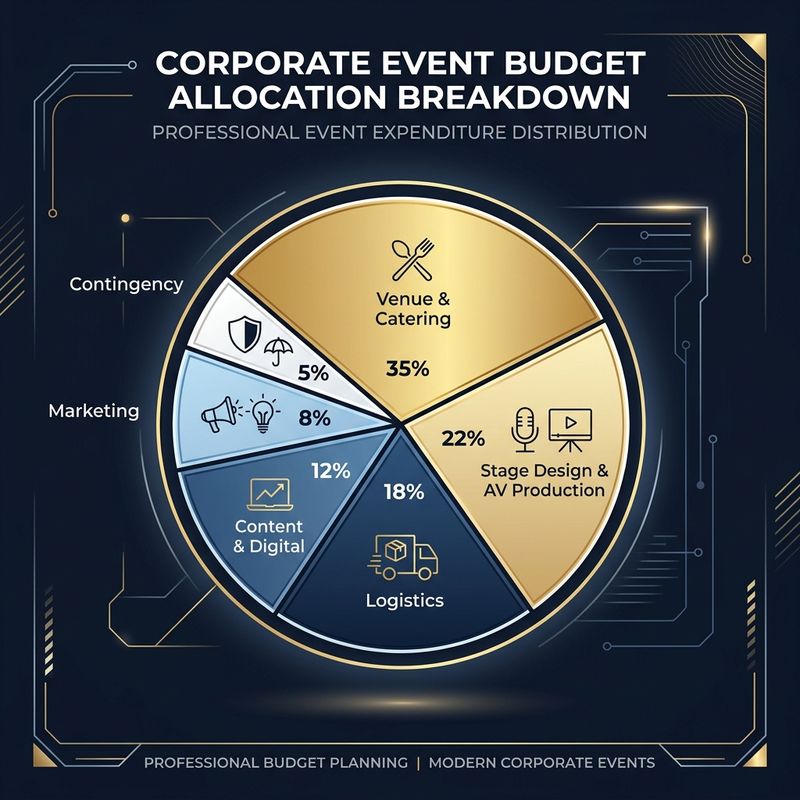 Corporate event budget allocation infographic
Recommended Budget Allocation
A professional corporate event budget typically follows this distribution:
- Venue and catering: 30-40%
- Stage design, AV, and technical production: 20-25%
- Logistics (transportation, accommodation, transfers): 15-20%
- Content production and digital integration: 10-15%
- Marketing and communications: 5-10%
- Contingency fund: 5-10%
Budget Management Tips
Watch out for hidden costs. Beyond venue rental, factor in electrical infrastructure, security personnel, insurance, municipal permits, and crew accommodation. An experienced corporate event management company identifies these hidden line items early, preventing budget surprises.
Leverage early booking advantages. Securing venues, hotels, and flights 3-4 months in advance can yield 15-25% savings — a significant difference for large-scale events.
Explore sponsorship opportunities. Particularly for congresses and summits, sponsorship revenue can cover a substantial portion of your budget. Prepare a compelling sponsorship prospectus that clearly articulates the value proposition for potential sponsors.
3. Choosing the Right Venue
The venue sets the tone for your entire event. A poor venue choice can overshadow even the most brilliant planning in every other area.
Key Venue Selection Criteria
Capacity and layout flexibility: Choose venues with at least 20% more capacity than your expected attendance. Verify that the space can accommodate different seating configurations — theater, classroom, U-shape, cocktail — depending on your program flow.
Technical infrastructure: For a professional corporate event, the venue's electrical capacity, internet connectivity (fiber optic preferred), ceiling height (minimum 4-5 meters for truss rigging), and acoustic properties are non-negotiable.
Accessibility and transportation: Prioritize venues with strong public transport links and adequate parking. For international events, proximity to the airport is a critical factor that directly affects attendee satisfaction.
Catering quality and flexibility: Determine whether the venue provides in-house catering or allows external providers. Ensure they can accommodate dietary requirements including vegan, gluten-free, halal, and kosher options — essential for international events.
Why Istanbul for Your Corporate Event?
Istanbul stands at the crossroads of Europe and Asia, offering world-class congress centers and event venues alongside a rich cultural tapestry that transforms any corporate event into an unforgettable experience. Venues such as the Istanbul Congress Center (ICC), Hilton Bomonti, Lütfi Kırdar, and Haliç Congress Center provide state-of-the-art facilities for events of any scale.
With Istanbul Airport's global connectivity — direct flights to over 300 destinations — your international attendees enjoy seamless access. Combined with Turkey's competitive cost structure compared to Western European capitals, Istanbul delivers exceptional value for corporate event organizers seeking global-standard quality.
4. Stage Design and Technical Production
Stage design is the visual heartbeat of your corporate event — it directly shapes attendee perception and the overall experience. Professional stage design and production transforms an ordinary meeting room into an immersive brand experience.
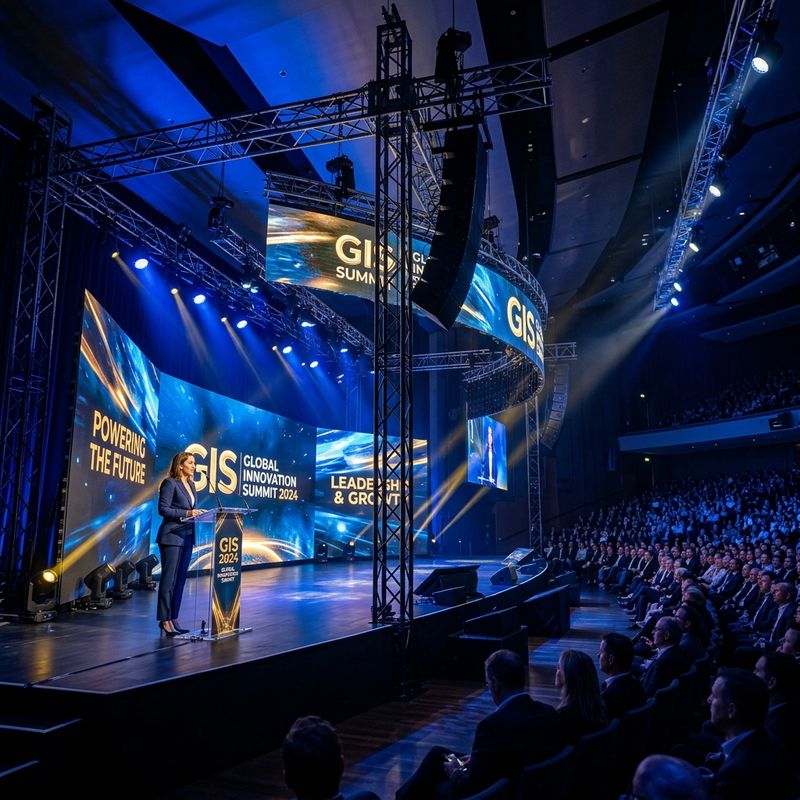 Professional stage design and LED screen setup
Core Elements of Stage Design
Brand integration: Your stage should be a three-dimensional expression of your brand identity. From LED screen content to floor finishes, from lighting colors to scenic elements — every detail must maintain brand consistency. Corporate colors, logo placement, and typography should follow your brand guidelines across every visual touchpoint.
Lighting design: Lighting has the power to completely transform a space. Moving head fixtures, wash lights, gobo projections, and LED strips create dramatic atmospheres tailored to each moment of your program. Separate lighting scenarios for the speaker area, audience zone, and networking spaces ensure each area serves its purpose perfectly.
Sound system: A sound system matched to the venue's acoustic properties is critical for event success. Line array systems deliver uniform sound distribution in large spaces, while stage monitors provide clear foldback for speakers. Wireless microphone backups should always be on standby for any technical contingency.
LED screens and visual content: High-resolution LED displays have become indispensable in modern corporate events. IMAG (Image Magnification) systems project close-ups of speakers onto large screens, while real-time graphics management enables live data feeds and dynamic animations throughout the program.
Trending Stage Technologies in 2026
- Interactive LED floors: Floor panels that react to attendee movement, creating dynamic visual effects
- Holographic projections: 3D holograms for product reveals and presentations
- AR (Augmented Reality) integration: Attendees interact with stage content through their smartphones
- Sustainable scenic design: Recyclable and reusable stage elements that reduce environmental impact
5. Logistics Management and Attendee Experience
Seamless logistics is the invisible backbone of attendee satisfaction. From a delayed airport transfer to a disorganized registration desk — every logistical hiccup directly impacts how your event is perceived.
Transportation and Transfers
For events with international attendees, VIP transfer and logistics management becomes mission-critical:
- Airport meet-and-greet: Personalized welcome signage with a professional host team
- Shuttle services: Regular hotel-to-venue ring routes running on tight schedules
- VIP vehicles: Dedicated car service for C-suite guests and keynote speakers
- Real-time tracking: Vehicle GPS tracking to minimize delays and enable proactive communication
Accommodation Management
For multi-day events, hotel and accommodation management directly impacts attendee satisfaction. Negotiate group rates with hotels, and offer accommodation options across different budget tiers to cater to all attendee segments.
Registration and Accreditation
Digital registration systems accelerate event entry while providing valuable data insights:
- QR code check-in: Eliminates queues and reduces wait times to seconds
- RFID badge tracking: Enables session attendance tracking and networking analytics
- Event mobile app: Delivers the program agenda, venue maps, speaker bios, and push notifications in one place
6. Digital Integration and Hybrid Events
In 2026, corporate event planning exists at the intersection of physical and digital experiences. The post-pandemic business landscape has made digital and hybrid event solutions a standard expectation rather than an exception.
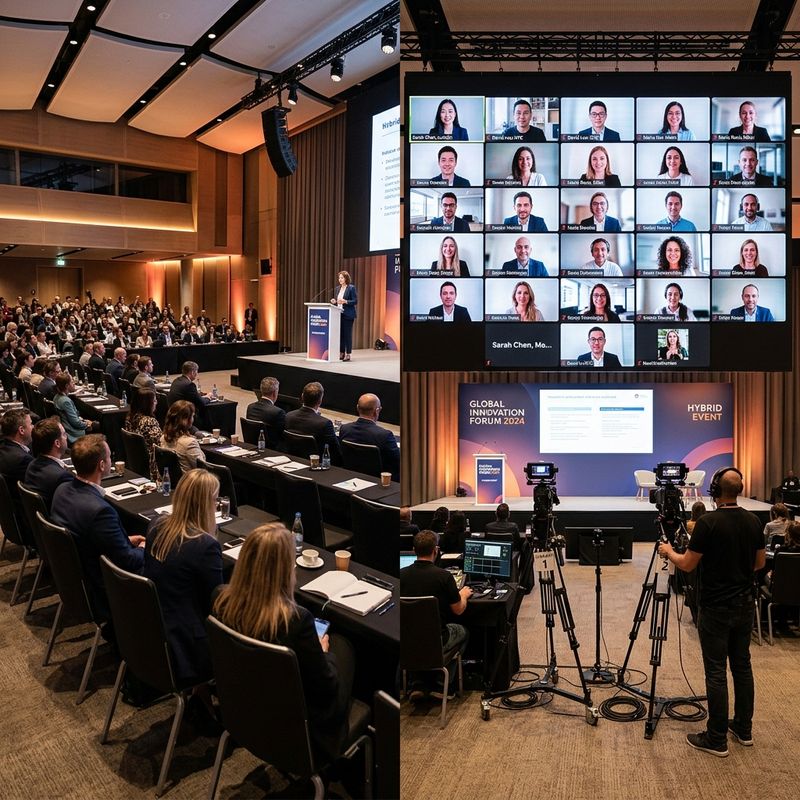 Hybrid corporate event setup - physical and digital participation
The Hybrid Event Model
Hybrid events unite in-person and remote attendees in a single, synchronized experience. For a successful hybrid event:
High-quality livestream infrastructure: Multi-camera setups, a professional vision mixer, and a stable internet connection (minimum 50 Mbps upload) are essential. A backup internet line is non-negotiable — a stream failure during a keynote is unrecoverable.
Remote attendee engagement: Live Q&A modules, polling and voting tools, and virtual networking rooms ensure remote participants are active contributors, not passive viewers.
On-demand content access: Post-event access to session recordings, presentation materials, and supplementary resources extends the life of your event and maximizes ROI long after the final session ends.
Social Media Strategy
Build a social media strategy that spans pre-event, live, and post-event phases:
- Event hashtag: Create a consistent, short, and memorable hashtag used across all channels
- Live content: Behind-the-scenes footage, speaker interviews, and highlight moments shared in real time
- User-generated content: Photo stations and interactive installations that encourage attendees to share their own content
- Post-event amplification: Summary videos, infographics, and attendee testimonials that continue generating engagement
7. Post-Event: Measurement and Evaluation
A successful corporate event planning process doesn't end when the last attendee leaves. Post-event analysis forms the foundation for improving future events and demonstrating return on investment (ROI) to stakeholders.
Key Measurement Metrics
Attendee metrics:
- Registration vs. actual attendance rate
- Session-by-session attendance distribution
- Mobile app engagement statistics
Engagement metrics:
- Social media reach and engagement rate
- Livestream viewer counts and watch duration
- Q&A and poll participation rates
Business metrics:
- New business connections generated
- Opportunities added to the sales pipeline
- Media coverage and equivalent PR value
Collecting Feedback
Send a concise satisfaction survey to attendees within 24-48 hours of the event. Keep the survey under 5 minutes and include both quantitative (1-10 ratings) and qualitative (open-ended) questions. The insights gathered become direct inputs for your next event planning cycle.
8. Corporate Event Trends Shaping 2026
Five shifts are changing what attendees expect from a corporate event. None of them replace the fundamentals above — they change how those fundamentals are executed.
Immersive design that pulls the audience in
Audiences no longer accept being seated in front of a stage for three hours. Projection-mapped surfaces, 360° staging, scent and sound zoning, and walk-through brand environments turn attendance into participation. The practical implication for planning is spatial: immersive formats need more floor area per guest and longer build time than a classic theatre layout.
Sustainability as a procurement requirement
Sustainability has moved from a nice line in the post-event report to a condition in the brief. Reusable modular staging instead of single-use build, digital badging instead of printed collateral, local and seasonal catering, and measured waste diversion are increasingly specified up front. Corporate clients with published ESG targets now ask for the numbers afterwards, so decide during planning what you will be able to report.
Personalised attendee experience
Segmentation has reached the event floor. Personalised agendas, matchmaking between attendees, role-specific content tracks and tailored welcome messaging measurably lift satisfaction scores. The requirement this creates upstream is data: a clean registration dataset is what makes personalisation possible at all.
Technology in stage production
LED surfaces keep replacing traditional set construction, real-time graphics allow content to respond live to what happens in the room, and camera automation makes broadcast-grade capture affordable at mid-size events. The constraint is rarely the technology — it is producing content that is authored for the actual screen geometry rather than adapted at the last minute.
Brand storytelling on stage
The strongest corporate events carry a single narrative from the invitation through to the closing moment, with the stage changing state as that narrative progresses. This is a design decision, not a decoration decision, and it has to be made before the set is drawn rather than added afterwards.
Each of these trends has a cost and a lead-time consequence. Decide which two or three genuinely serve your objectives, and resist the temptation to apply all five at once.
Conclusion: Elevate Your Events with Professional Partnership
Corporate event planning is an intricate discipline that requires the seamless coordination of dozens of moving parts. Strategy, budgeting, venue selection, stage design, technical production, logistics, and digital integration — each phase demands its own expertise.
At BACKSTAGE Event, we manage the entire process under one roof — from concept to execution. With years of experience, a robust vendor network, and a creative team passionate about perfection, we're ready to bring your corporate event to life at global standards.
Ready to start planning your next corporate event? Get in touch with us today and let's bring your vision to the stage.
This guide was prepared by the BACKSTAGE Event editorial team, informed by current industry trends and expert insights. Last updated: April 2026.
Frequently Asked Questions
How far in advance should corporate event planning begin?+
While timelines vary by scale, a general guideline: large congresses and summits (500+ attendees) require 6-8 months, mid-size corporate events (100-500 attendees) need 3-4 months, and smaller events should begin planning at least 6-8 weeks in advance. Venue and keynote speaker bookings should be secured as early as possible.
How do I estimate a corporate event budget?+
A rough formula is: number of attendees × cost per head. In Turkey as of 2026, per-person costs for a mid-scale corporate event range from approximately €30 to €250, depending on the event type, venue category, and production complexity. Stage design, AV production, and custom content creation are the primary variables that move the budget upward.
What are the benefits of working with a professional event company?+
Partnering with an experienced event management company delivers time savings, cost optimization through established vendor networks, professional risk management, and creative solutions that elevate the attendee experience. In specialized areas like stage design, AV production, and logistics coordination, professional expertise directly translates to higher event quality.
Should I choose a hybrid event or a fully in-person format?+
This depends on your audience and objectives. If you have international attendees, a hybrid format reduces travel costs and expands reach significantly. For events where face-to-face networking is paramount — such as product launches and gala dinners — a fully in-person format delivers stronger impact. In 2026, many global organizations have adopted hybrid as their default approach, combining the advantages of both formats.
Why choose Istanbul as a corporate event destination?+
Istanbul's strategic position at the crossroads of Europe and Asia, world-class congress infrastructure, rich cultural experiences, and competitive pricing make it an ideal destination for international corporate events. Istanbul Airport's connectivity to 300+ global destinations ensures easy access for attendees worldwide. Compared to London, Paris, or Frankfurt, Istanbul typically offers 30-50% cost savings while delivering comparable — or superior — venue quality and hospitality.
Subscribe to Our Newsletter
Subscribe to our newsletter for event trends, design insights, and exclusive content.


