


BACKSTAGE Event
BACKSTAGE Event is an Istanbul-based corporate event and MICE organization company. Our expert team specializes in congresses, conferences, product launches, and gala events, bringing every project from backstage to the stage.

Event production in Turkey is the technical side of an event: the stage and set, lighting, sound, LED screens, power, rigging and, for hybrid events, the cameras and streaming that carry the programme to an online audience. A production company turns the design into build drawings and sources the equipment. It installs everything in the venue, runs it on the day and takes it down afterwards. The work is the same for a congress, a launch, a gala or a beach party. What changes is the scale and what the venue allows.
This guide explains each part of that work, from the stage build to the show-day timeline. It also covers what moves the cost and the questions to ask before you sign with a production partner. It applies to any event type. For the strategy, PR and guest side of a launch, see our product launch planning guide.
Last updated: October 2026. Project details are as published on our project pages, checked in October 2026.
Contents
- Event production in Turkey: what it covers
- What an event production company in Turkey does
- Stage and set: design, build and rigging
- Lighting, sound and LED screens
- Power, safety and venue rules in Istanbul
- Hybrid event production
- What event production costs in Turkey
- Timeline: from brief to show day
- How to choose an event production company in Turkey
- Production we have delivered
1. Event production in Turkey: what it covers
The short answer
A venue gives you a room, a floor and some power sockets. A beach gives you sand and a view. Event production is everything brought in to turn that space into the event. It covers what the audience looks at, what they hear, what the cameras record and the infrastructure that keeps it running safely. The work can go to one production company that answers for all of it, or to separate suppliers, each answering only for its own equipment.
The disciplines inside it
- Stage and set: decks, risers, backdrops, branded walls, platforms and anything built for the event.
- Lighting: the rig that lights presenters, performers and the room, and the structure it hangs from.
- Sound: speakers, microphones, stage monitors and the desk that mixes them.
- Video: LED walls, projection, playback, countdown displays and camera feeds.
- Power and structures: distribution, cabling, rigging points, truss and ground support.
- Broadcast: cameras, vision mixing and streaming when part of the audience is online.
- Show control: the running order and the cues that tie the rest together.
Why the event type changes the job
The disciplines stay the same, but the priorities move. A congress needs clear speech in every seat and tight session timing, and often interpretation. A launch builds towards a reveal. A seated gala has to fit a stage and a dance floor around round tables. An open-air event has to bring in everything a building normally provides, including power. Section 10 shows how this worked on six of our projects.
2. What an event production company in Turkey does
The people on a production
A production is run by a small core team and a larger crew. The producer owns the budget, the schedule and the relationship with the client and the venue. The technical director turns the design into drawings and makes sure lighting, sound, video and staging fit together in the room. On show day, the technical director is responsible for the technical running of the show. Under them work the heads of lighting, sound and video, the riggers, the stage crew and the electricians. On a small event one person may cover two roles. On a large one, each department has its own team and shifts.
Owned and hired equipment
No production company owns every item for every event. Many keep a stock of core equipment and hire the rest for larger or specialist jobs. Owned equipment gives control over its condition and availability, and over who knows how to run it. Hired equipment gives scale. Neither approach is wrong, but you should know which is which. Ask what is owned and what is hired. Ask who operates the hired items, and who is responsible if something fails during the show.
Production, not event management
Production is the technical layer. Guest lists, registration, catering, hotels and transport belong to event management. Some companies do both under one contract, and others do only production. If you hire them separately, decide early who owns the running order. Both sides depend on it: the producer needs it to build the cue list, and the event manager needs it for catering and speakers.
3. Stage and set: design, build and rigging
From design to build drawings
Stage design decides how the stage looks and how it serves the programme. We cover those rules in 7 golden rules of stage design, which also discusses what stage design costs in Istanbul. This section covers the production decisions only.
Once a design is approved, it has to become build drawings that fit the actual room. The drawings fix the deck size and height, the stairs and access, and where the screens sit. They also show what is built in the workshop, what is assembled on site and how each piece travels through the venue's doors and corridors. Our product launch and stage production team builds from drawings like these.
Hanging it or standing it
Lighting, screens and set pieces either hang from the venue's rigging points or stand on ground-supported truss and towers. Hanging keeps the floor clear and the sightlines open, but it depends on what the building allows, and some buildings allow very little.
The Ford launch took place in the courtyard of a historic Istanbul venue where drilling and heavy rigging were not permitted. The whole build had to be designed around the site. On the sand at the Toyota beach event there were no fixed rigging points at all, so every element was ground-supported. Find out which situation you are in before the design is approved, not after.
Load calculations and paperwork
Anything that hangs over people or stands in the wind carries load, and someone has to have calculated it. A production company should be able to show the load calculations and certification for the structures and rigging it builds. International industry standards exist for this work. For example, the European standard EN 17115 covers the design and manufacture of aluminium and steel trusses. Whether a given standard is mandatory in Turkey is a separate question. For you, the test is simple: the supplier should put the numbers on paper before the build starts.
4. Lighting, sound and LED screens
Lighting: where it hangs and who runs it
Lighting, sound and video are the core of technical event production. The lighting questions are practical:
- Where does the rig go?
- How many fixtures does the room need?
- How much programming time does the operator get before rehearsal?
- Is the event being filmed? Lighting for cameras is not the same as lighting for a room.
At the Webrazzi summit, the conference stage had a trussed lighting grid. A larger hall may need moving heads on truss to change the look between sessions. How light is used creatively is a design question, covered in the stage design article.
Sound: coverage, monitors and backline
Sound has two audiences: the people in the seats and the people on stage. Line array systems cover large rooms and open-air sites evenly, and stage monitors let presenters and performers hear themselves. A band adds backline, the amplifiers and instruments it plays through, and its own monitor mix. A congress adds wireless microphones for panels and audience questions, plus a feed for interpreters and for the stream. Outdoors, the system also has to work within the sound limits described in section 5, which can change what you hire.
LED screens and video
LED walls are rented by surface area and by the day. The panels come in different pixel pitches. A finer pitch looks sharp from close up; a coarser pitch suits a large wall seen from a distance. Pitch is one of the factors in the price.
The wall has to be built and taken down, which takes crew and time in the schedule. It also needs an operator and someone to manage the content. That content can include slides, videos, live camera feeds, sponsor loops and functional displays, such as the countdown display we built for session timing at Webrazzi. Agree early who prepares the content, in what format and by when.
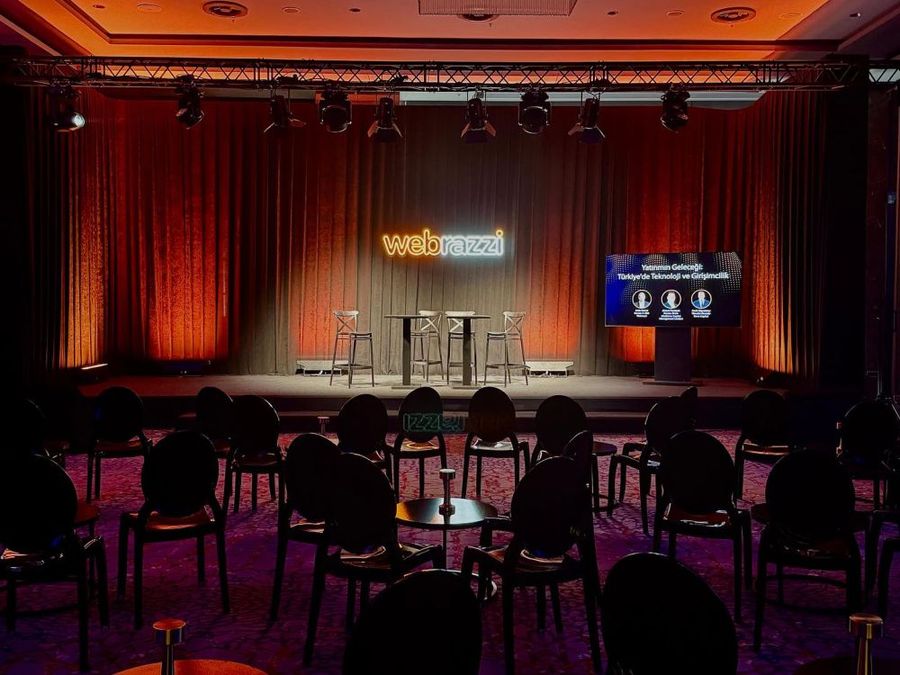 Conference stage with orange-lit curtains under a truss lighting grid, a neon Webrazzi logo, a session screen and high tables, with rows of chairs facing it, at the Webrazzi summit - BACKSTAGE Event production
5. Power, safety and venue rules in Istanbul
Power and distribution
Every lamp, speaker and LED panel needs power. Power planning starts with one question: how much power does the venue have, and where are the supply points? A hotel ballroom or congress centre has fixed supply points with a set capacity, and the production plan has to fit within it or bring in extra supply. An open-air site may have none. At the Toyota beach event there was no fixed power at all. Whatever the source, an authorised electrician should make the electrical connections. The distribution boards should have residual current devices, which cut the power if current leaks.
Working at height
Work at height covers any task where a fall from a difference in level could injure someone. On a build, that can include rigging, truss climbing, scaffold towers and a raised stage edge. Good practice puts collective protection first, such as guardrails, platforms, barriers and nets, before relying on each person's harness. Ask three things: how the crew will work at height in your venue, who supervises it, and how the area under the rigging is kept clear during the build.
Sound limits, permits and venue rules
Amplified sound has local limits on time and area. The venue knows its own limits. For open-air events, the municipality and local authorities decide which areas and times are suitable. Get these limits confirmed in writing before design starts. They decide the sound system and the running order, and sometimes the venue itself.
Venues also set rules of their own:
- load-in windows and access routes
- floor protection
- whether drilling is allowed
- which suppliers they approve
Read them before the drawings are final.
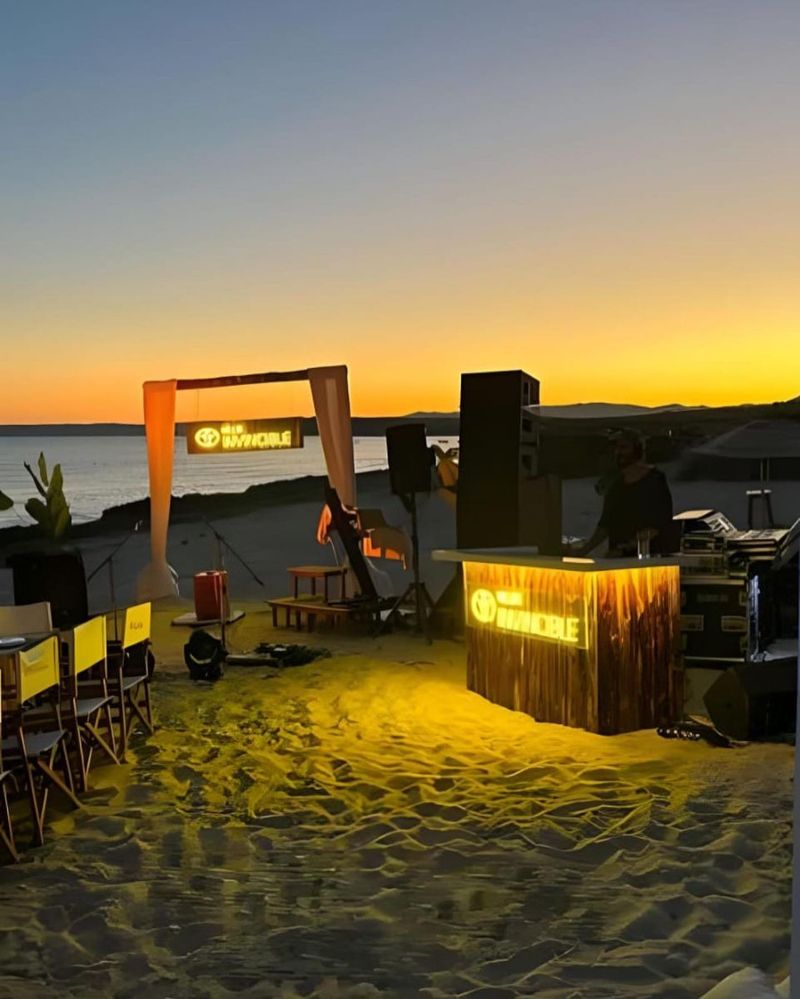 Freestanding entrance arch with an illuminated Hilux Invincible sign, a lit wooden DJ booth, speakers on stands and folding chairs on the sand at sunset, at the Toyota beach event - BACKSTAGE Event production
6. Hybrid event production
Two audiences, one show
Hybrid event production adds an online audience to the room. The extra layer includes:
- cameras and a vision mixer to cut between them
- graphics and a stream encoder
- a reliable network connection
- recording
- a way to bring remote speakers onto the main screen, so the room sees them as clearly as online viewers do
The room and the stream have to run as one show from one running order. Our digital and hybrid event solutions cover this side of production.
The network and the room
In a hybrid event, the connection is as critical as the cameras. The main line and any backup line have to be decided venue by venue, with the venue's technical team and the network provider, because buildings vary widely. Some large congress centres publish in-house broadcast, video conference and simultaneous interpretation equipment. Haliç Congress Center is one of them. At other venues, the production company brings the broadcast equipment in. Lighting matters here too, because a stage lit only for the room often looks flat on camera.
Interpretation for international audiences
International congresses add simultaneous interpretation. That means booths and consoles, receivers for delegates, and clean audio to the interpreters and back. The international standard for this equipment, ISO 20109, was revised in 2025. On a hybrid event, each language channel may also go out on the stream. Plan interpretation with the programme, not after it, because interpreters need slides and speeches in advance. For the wider congress picture, see our congress and summit organisation service.
7. What event production costs in Turkey
Why there is no price list
Production is quoted per event. Two events with the same guest count can need very different builds. We price production for each event, so a fixed price list would mislead you. For indicative stage design budgets in Istanbul, see the cost section of the stage design article linked in section 3. What we can explain here is what moves the total.
The items that move the total
- Days. Equipment is rented by the day, and those days include build, rehearsal and strike as well as the show. Adding a rehearsal day the day before adds a rental day.
- Size. LED walls are priced by surface area. Stages depend on area and height. Lighting and sound depend on how many fixtures and speakers the room needs.
- Pixel pitch. The pitch you choose is one of the factors in the LED price.
- Transport and location. Equipment and crew travel from the warehouse. A site outside the city costs more to reach than a central hotel.
- Set-up and strike. Labour hours rise with short load-in windows and night work.
- Operators and content. Each department needs people to run it on the day, and someone has to manage screen content.
- Insurance. Equipment and crew have to be covered for the days on site.
- Venue limits. No rigging points means ground support. No power means bringing in supply. Heritage rules mean more design time.
- Custom builds. Branded set pieces made for one event cost more than stock decks.
- Hybrid. Cameras, crew, network and a stream operator form a production layer of their own.
Reading a quote
A useful quote lists these items line by line, with days and quantities, so you can see what changes when the design changes. Public buyers work the same way. In 2025 one Istanbul district municipality put sound, lighting, stage and LED screen rental out to tender as one service, split into itemised lines over a contract period. Compare quotes item by item, and ask what each one assumes about days, crew and venue access.
8. Timeline: from brief to show day
Before anything is built
The order of steps matters more than any fixed number of weeks:
- Brief: date, venue, guest count, programme and budget.
- Technical site visit with the venue, to check access, power, rigging and restrictions.
- Drawings and a first quote, then revisions.
- Approvals from the venue and, for open-air events, the municipality.
- Design freeze before production starts, with content deadlines set at the same time.
Late design changes put the whole schedule under pressure.
Load-in, build and rehearsal
Build day follows a fixed order. Rigging goes in first, while the floor is still clear. Stage and set follow, then lighting, sound and video, then focusing and programming. The build ends with a technical rehearsal, and a full rehearsal with presenters if the programme allows it. The venue sets the load-in window, and that window decides the crew size: a short window needs more people working at once.
Show day and strike
On the day, the show runs from the running order, with each technical cue agreed in advance. The contingency plans should already be written: a backup laptop for playback, spare microphones, a weather plan outdoors and a backup line for the stream. When the last guest leaves, the strike begins, often under the same time pressure as the build. It ends when the venue is handed back in the agreed condition.
9. How to choose an event production company in Turkey
Questions about the team
- Will we have a dedicated technical director on site from build to strike?
- Who is our single point of contact, and will they be at the venue on show day?
- When will your team join the venue walkthrough?
- How do you run a technical rehearsal, and what happens if one department is not ready?
Questions about equipment and paperwork
- Which equipment do you own, and which will you hire?
- Which parts of the job go to subcontractors, and who manages them on site?
- Can you show load calculations and certification for the structures and rigging you will build?
- Who makes the electrical connections, and how is the distribution protected?
- What insurance covers the equipment and the crew?
Questions about what can go wrong
- What is the weather plan for an open-air site?
- What is the backup for power, playback and the stream?
- How will you work within the venue's sound limits and load-in window?
- Which projects have you produced in similar conditions, and can we see them?
A company that answers these clearly, with names and documents, will be easier to work with than one that only has a strong showreel.
10. Production we have delivered
Conference and congress stages
For the Webrazzi summit we built a conference stage with a trussed lighting grid and a countdown display for session timing (see section 4).
The Eurasia Blockchain Summit in Istanbul needed full congress production. The scope ran from the outdoor arrival route and accreditation area through to the main hall. The build included a large-format LED wall, a trussed moving head rig, line array sound, a press wall and sponsor branding across the venue. The job was to make one route and one hall work as a single production.
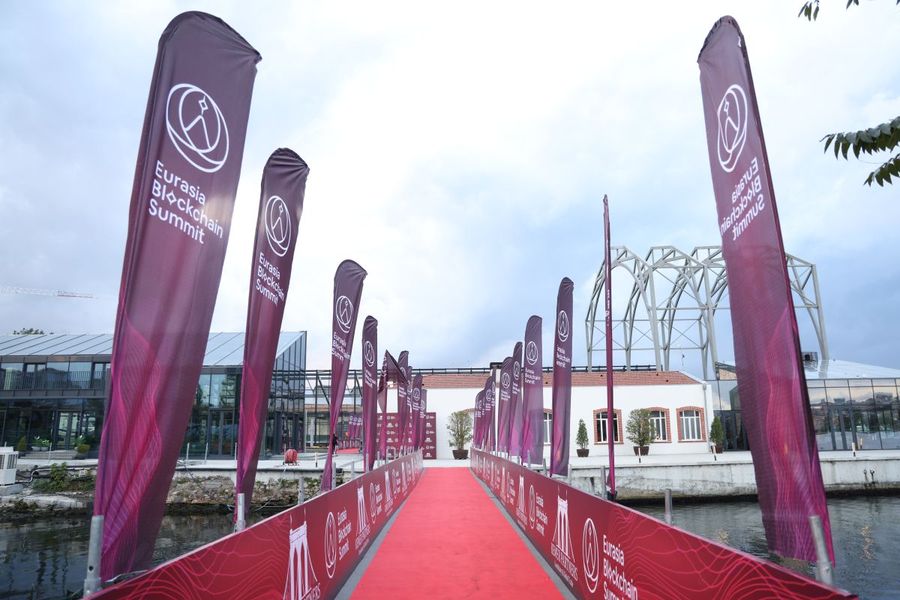 Red-carpet arrival walkway lined with Eurasia Blockchain Summit feather flags and branded barrier panels - BACKSTAGE Event production
Launches and brand spaces
The Ford launch introduced the new Kuga and Mustang Mach-E. We delivered raised vehicle platforms, illuminated model lettering, façade uplighting and the full technical production (see section 3).
The Esperienza Ferrari brand lounge was a different kind of build. A plain hall became a branded environment with:
- a full-height red wall treatment
- the prancing horse and wordmark applied to the walls
- a large-format screen wall
- modular seating laid out for guest circulation
Here the production was the set itself, not a stage.
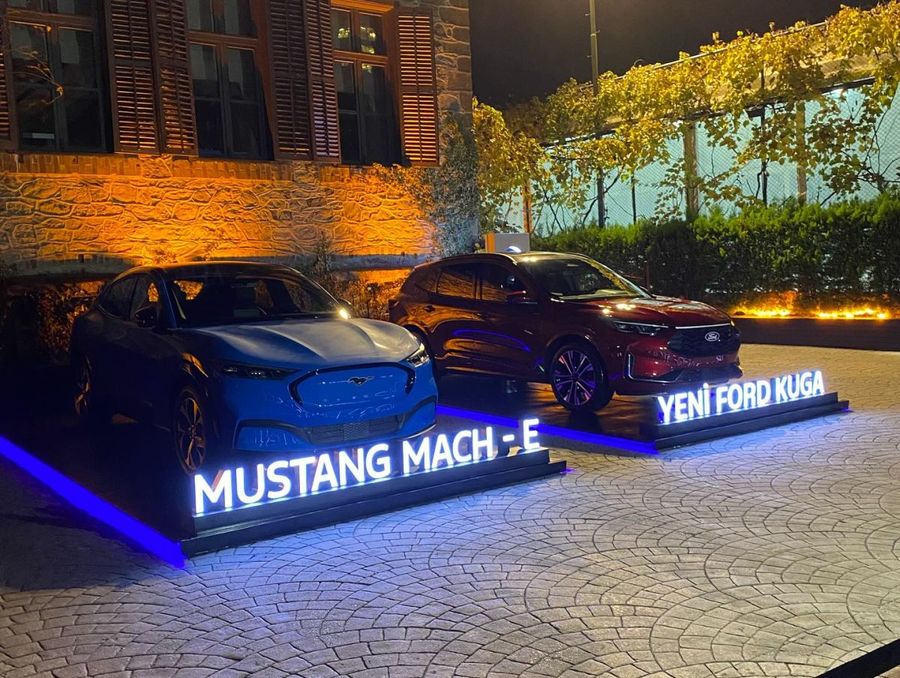 Mustang Mach-E and new Ford Kuga on raised platforms with illuminated model lettering, in a cobbled courtyard with orange uplighting on the stone façade after dark - BACKSTAGE Event production
Open-air builds
For the Lexus "RX ile Müziğin Peşinde" campaign we produced a live music evening in a garden. We delivered the stage deck, backline, monitor system, an illuminated brand logo and the lighting plan for a night-time outdoor performance.
The Toyota event was a sunset brand event staged directly on the sand, with a freestanding entrance arch, an illuminated DJ booth, line array sound and lighting (see section 3 for how the site shaped the build).
Planning Event Production in Turkey
Every production starts with the same few facts. Contact us with your event date, venue and guest count, and tell us whether part of the audience will join online. We will tell you what the venue allows, what the build involves and which questions to settle before design starts.
Frequently Asked Questions
What does an event production company in Turkey do?+
It handles the technical side of an event: stage and set, lighting, sound, LED screens, power, rigging and, for hybrid events, cameras and streaming. It turns the design into build drawings, sources or hires the equipment, installs it in the venue, runs the show with a technical director and takes everything down afterwards.
What is involved in hybrid event production in Turkey?+
Hybrid production adds an online audience to the room: cameras, vision mixing, graphics, a stream encoder, recording and a way to show remote speakers on the main screen. The network line and its backup are decided venue by venue with the venue and the provider. International congresses may also need simultaneous interpretation feeds for each language.
What does technical event production in Turkey include?+
Lighting, sound, LED screens and video, power distribution, rigging and show control. In practice that means deciding where the rig hangs or stands, how much power the venue has, how many speakers and fixtures the room needs, who operates each department and who manages screen content. Electrical connections should be made by an authorised electrician.
How does stage design work in Turkey?+
Stage design decides the look and how the stage serves the programme; production turns it into build drawings that fit the venue. Check early whether the venue allows rigging from its ceiling or needs ground-supported structures, as heritage and open-air sites often do. Ask the supplier for load calculations and certification for everything it builds.
What should I check before booking event production in Istanbul?+
Confirm the venue's power supply, rigging options, load-in window and supplier rules. Get the local limits on amplified sound confirmed in writing by the venue, and by the municipality for open-air events, before design starts. Then ask the production company who your technical director is, what is owned or hired, and what the backup plans are.
Subscribe to Our Newsletter
Subscribe to our newsletter for event trends, design insights, and exclusive content.


