


BACKSTAGE Event
BACKSTAGE Event is an Istanbul-based corporate event and MICE organization company. Our expert team specializes in congresses, conferences, product launches, and gala events, bringing every project from backstage to the stage.

A beach wedding in Turkey is not one decision — it is a choice between four very different coastlines. The turquoise lagoon at Ölüdeniz, the beach clubs of Bodrum, the long Mediterranean sands around Antalya and the quiet coves near Marmaris all deliver "married by the sea", but they suit different guest counts, different budgets and, crucially, different weather.
This guide covers where to marry on the Turkish coast, what a ceremony on sand actually involves, and how season and wind shape the hour you say your vows. We produce weddings and large-format events across these regions, so it is written from the build side. The legal steps and the national cost picture are in our broader destination wedding in Turkey guide; here we stay on the coast.
Last updated: September 2026. Figures are indicative planning bands, not quotes — every venue prices differently.
Table of Contents
- Why a Beach Wedding in Turkey Works
- Ölüdeniz and the Blue Lagoon
- Fethiye, Marmaris and the Southern Coves
- Bodrum and Çeşme: Beach Club Weddings
- Antalya, Lara and the Mediterranean Sands
- What a Ceremony on Sand Actually Involves
- Season, Wind and the Right Hour
- The Legal Side: Symbolic on the Sand
1. Why a Beach Wedding in Turkey Works
Three things separate Turkey from the Greek islands, Croatia or the Amalfi coast for this particular kind of wedding.
The season is long
The Mediterranean coast runs comfortable beach weddings from late April to late October — six months, against roughly four in the northern Mediterranean. That length matters because it moves you out of the July–August peak, where hotel rates roughly double and midday heat makes an afternoon ceremony genuinely uncomfortable. Late May, June, September and early October are the sweet spots.
The supplier base is real
These are not resorts improvising a wedding once a summer. Bodrum, Fethiye and Antalya have florists, technical crews, celebrants and catering kitchens that do this weekly through the season, and they are used to working in English. That shows up in small things: a crew that already knows how to level a ceremony arch on sand, and a caterer who understands that plated service under a marquee at 35°C is not the same as in a ballroom.
Guests can actually afford to come
Flights into Dalaman, Bodrum and Antalya are direct from most of Europe and the Gulf, and a three-night stay costs a fraction of the equivalent in Italy or the south of France. When you are asking eighty people to travel, that is the difference between a full guest list and half of one.
2. Ölüdeniz and the Blue Lagoon
If you have seen one photograph of a Turkish beach wedding, it was probably taken here. The Blue Lagoon at Ölüdeniz — a sheltered inlet of impossibly clear water backed by pine-covered mountains — is one of the most photographed stretches of coast in the country.
What makes it work: the lagoon is a protected nature reserve, which means the backdrop cannot be built out or built over. The water is calm when the open sea is not, because the headland shelters it. And Babadağ rises directly behind, so the last light catches the mountain above you while the sun goes down over the water.
What to plan around: the lagoon itself is a protected area with restricted access and no permanent event infrastructure, so ceremonies happen at the hotels and beach venues along Ölüdeniz and Belcekız beach rather than on the reserve sand. Capacity at the intimate end suits 30 to 120 guests comfortably; larger counts move to resort grounds slightly inland with the sea in view.
The paragliding factor: Ölüdeniz is one of the world's busiest paragliding sites, and canopies come off Babadağ all afternoon. Most couples find it adds to the scene; if you want clean sky in your photographs, plan for after the last landing.
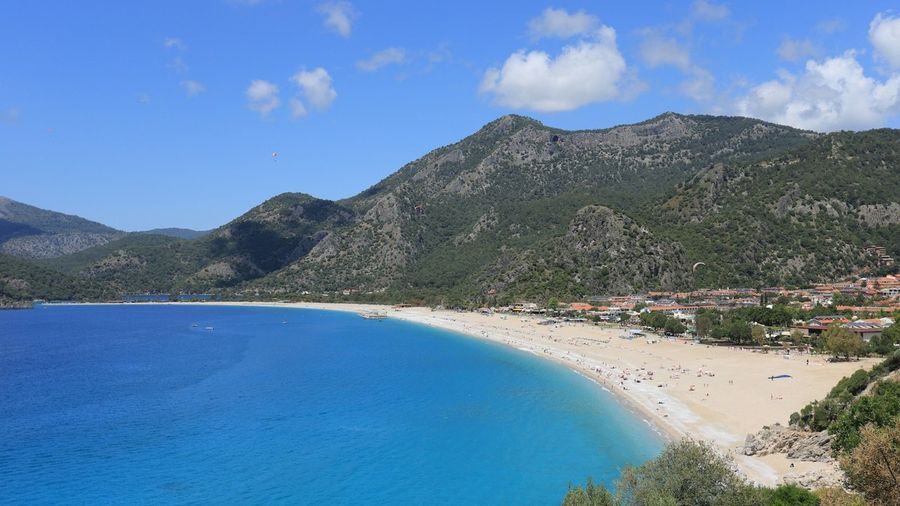 The bay at Ölüdeniz from above — turquoise water, the sand spit and pine-covered slopes behind
3. Fethiye, Marmaris and the Southern Coves
The coastline between Fethiye and Marmaris is where couples end up when they want the Ölüdeniz character without the Ölüdeniz booking pressure.
Fethiye puts you about half an hour from Ölüdeniz: the road climbs over Ovacık, so the distance is short and the drive is not. What you get in return is a working town behind you — more hotel choice, easier supplier access and a harbour full of gulets. A boat-based reception after a beach ceremony is a genuinely local option here, and one that solves guest transfers at the same time.
Marmaris and the coves around it — Turunç, İçmeler, Selimiye — trade the famous view for privacy. These are small pebble-and-sand bays with hotels built into pine slopes; several have private beaches that can be taken exclusively for a wedding at a fraction of what exclusivity costs in Bodrum. If your priority is that nobody outside the guest list is on the sand, this is the stretch to look at.
A practical note on pebbles: several of the prettiest coves here are shingle, not sand. It photographs beautifully and drains well after rain, but it is hard walking in heels and needs a laid aisle. Ask what the beach is actually made of before you fall in love with the photograph.
4. Bodrum and Çeşme: Beach Club Weddings
The Aegean coast north of Marmaris is where the majority of international weddings in Turkey actually happen, and the format is distinct: less "ceremony on empty sand", more beach club taken over for the night.
Bodrum's peninsula — Yalıkavak, Türkbükü, Gümüşlük — is built around venues that combine a private beach, a terrace for dinner and a pool deck that becomes the dance floor. The infrastructure is already there, which removes most of the build cost that an empty beach carries. Çeşme, opposite Chios, offers the same character about an hour from İzmir airport.
What you are buying: a venue that hosts weddings as core business, with a kitchen, staff, sound system, licences and a wet-weather alternative already in place. What you give up: exclusivity of setting — these are recognisable places, and your wedding will look like a beautiful version of something the venue does forty times a season.
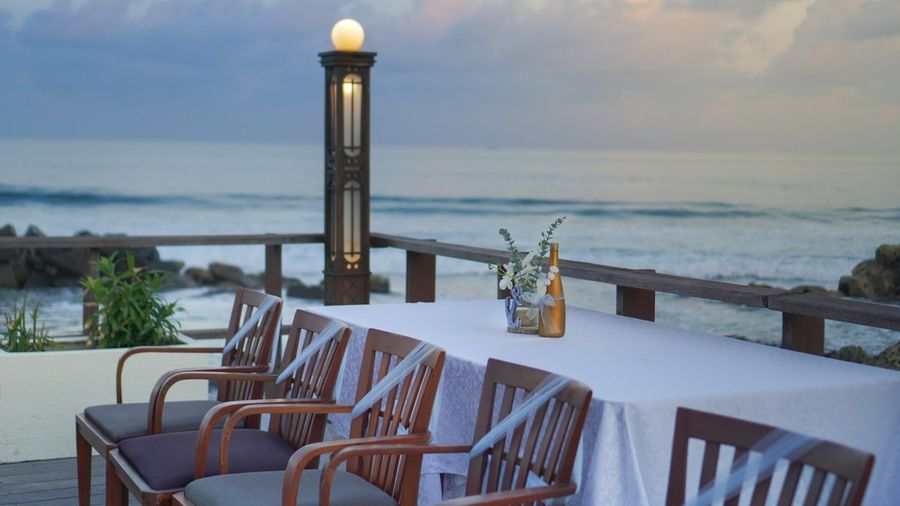 Long dinner table set on a waterside deck at dusk, lantern light and the sea beyond
Guest counts here run comfortably from 60 to 250. Above that, the peninsula's resort hotels take over; the venue-type breakdown in our Istanbul guide applies to the coast too, with hotels absorbing the same set of problems.
5. Antalya, Lara and the Mediterranean Sands
Antalya is the value answer, and for large guest lists it is often the only answer.
The Lara stretch east of the city is a continuous run of large resort hotels with private beaches, each capable of absorbing a 300-guest wedding without the couple building anything. Season runs longest here — late April through October — and the per-guest cost of accommodation is the lowest of any coastal region in this guide. Kaş and Kalkan, further west, offer the opposite character: low-rise, intimate, cliff-and-cove rather than long sand, and suited to 40 to 100 guests.
The trade-off at the resort end is atmosphere. A Lara beach wedding is efficient, comfortable and inexpensive per head; it is not intimate, and it will not look like Ölüdeniz. For many couples bringing a large family from abroad, that is exactly the right trade. Our hotel accommodation service negotiates the room block and the venue as one conversation rather than two.
6. What a Ceremony on Sand Actually Involves
The picture in your head is a couple, an arch and the sea. Here is what sits behind that picture.
The aisle
Sand does not walk well in heels, and an unlaid aisle turns the entrance into a careful shuffle. A laid aisle — timber deck, coir matting or a firm runner pinned at the edges — is not a decorative choice, it is what lets your guests arrive looking the way they planned to. Budget for it.
Seating and levelling
Chairs sink unevenly. Every chair either sits on a laid surface or gets levelled individually, and the same applies to anything with legs: the ceremony table, the arch, the sound stand. This is standard work for a coastal crew, but it takes time, which means access to the beach several hours before the ceremony.
Sound
Open sand and moving water absorb sound in a way a garden does not, and there is no wall to bounce a voice back off. A ceremony for more than about thirty guests needs microphones — a lapel for the celebrant and one for the couple — or the back three rows hear waves and nothing else.
The tide and the working beach
Ask two questions the brochure will not answer: where is the waterline at your ceremony hour, and is this beach public. Many of Turkey's prettiest beaches are public even where a hotel manages the loungers, which means the space behind your ceremony can be occupied. Venues manage this with a cordon and timing, but it must be planned, not assumed.
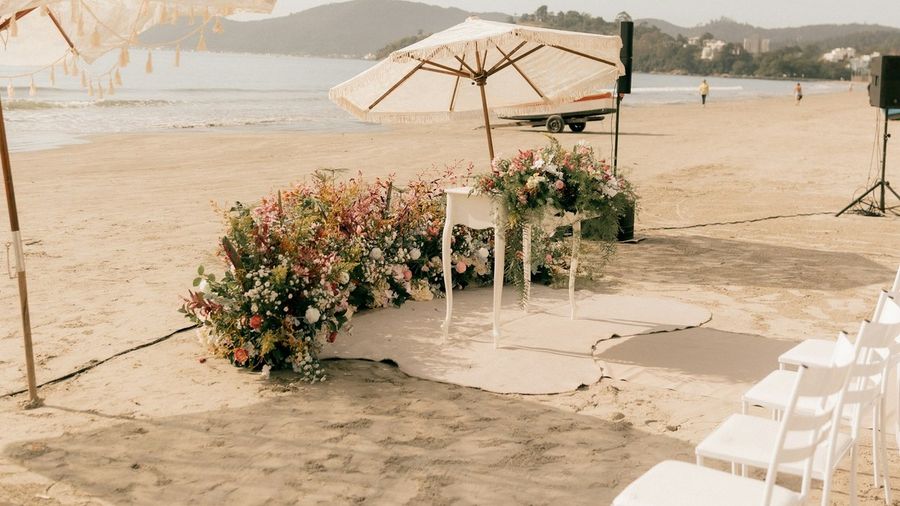 Beach ceremony setup: matting laid over the sand, white chairs, a floral installation and a speaker stand
7. Season, Wind and the Right Hour
Coastal weather in Turkey is regional, and the difference matters more than the calendar.
The Aegean breeze is a daily event, not a weather risk. From Bodrum up through Çeşme, an afternoon wind rises almost every summer day and eases toward sunset. It is the reason the coast is comfortable in August — and the reason a 16:00 ceremony on an exposed terrace involves holding onto everything. The local answer is not to fight it: ceremonies here are set for early evening, as the wind eases and the light turns. Easing is not the same as calm, though — in our destination wedding guide we record open-coast gusts still reaching 30–40 km/h at 21:00, which is why a stated wind threshold belongs in the contract even for an evening ceremony.
The Mediterranean coast is calmer and hotter. Around Antalya and Lara the sea breeze is gentler, which is pleasant for stability and unhelpful for temperature. Ceremonies move later — 18:00 or after — for heat rather than wind.
Ölüdeniz sits in its own microclimate. The lagoon is sheltered by the headland, so it stays workable when the open coast is choppy. That shelter is a real planning asset, and part of why the region books out early.
The same timing logic drives the photographs: the hour that suits the ceremony is the hour that suits the camera, and on this coast they are the same hour. Our overseas wedding photography guide covers how that planning works in practice.
The rest of the engineering — ballast, structure ratings, the take-down procedure itself — is covered in our destination wedding guide.
8. The Legal Side: Symbolic on the Sand
Most beach weddings in Turkey are two events, and it is worth knowing that they do not have to be.
The legal marriage is performed by a municipal registrar with translated and apostilled documents. The default is the register office, but it is not the only option: many coastal municipalities will send a registrar to an external venue — a villa, a hotel garden, the beach itself. It has to be booked well ahead, it carries a fee, and availability differs by district; it is common along the Aegean coast. The destination wedding guide covers the documents, timings and the apostille process.
The ceremony on the beach that most couples plan is nonetheless symbolic — led by a celebrant of your choosing, with no legal weight and no restrictions on where or how it happens. That is not a workaround, it is a choice: it decouples the paperwork from the day your guests fly in for, and most couples complete the civil formality earlier in the same week. If having the legally binding moment in front of your guests matters to you, ask the district early rather than assuming it cannot be done.
One coastal detail either way: the setup itself — arch, chairs, sound — needs clearance from the venue or the municipality. Private hotel beaches handle it internally; independent stretches do not. Confirm who issues it before you book anything else.
Planning a Wedding on the Turkish Coast
We produce weddings, galas and large-format events across Turkey — venue sourcing, contracting, production and the run of the day. You can see the scale of what we build in our project portfolio, read more about our wedding and gala management service, or browse the weddings section for the full picture. Guest transfers from Dalaman, Bodrum or Antalya airports are part of what we handle — see VIP transfer and logistics.
If you have a date, a rough guest count and a coast in mind, that is enough to start a shortlist. Get in touch and we will come back with options that fit the brief.
Frequently Asked Questions
Where is the best place for a beach wedding in Turkey?+
It depends on guest count. Ölüdeniz and the Blue Lagoon suit 30–120 guests and give one of the most photographed backdrops in the country; Bodrum and Çeşme beach clubs handle 60–250 with infrastructure already in place; Antalya and Lara absorb 300 or more at the lowest cost per guest.
When is the best time for a beach wedding in Turkey?+
Late May, June, September and early October. The Mediterranean coast is comfortable from late April to late October, but July and August bring peak hotel rates and midday heat that makes an afternoon ceremony hard work. On the Aegean, marry in the early evening as the daily wind eases.
Can you get married at the Blue Lagoon in Ölüdeniz?+
Not on the reserve sand itself — the lagoon is a protected area with restricted access and no event infrastructure. Ceremonies take place at hotels and beach venues along Ölüdeniz and Belcekız beach, with the lagoon and Babadağ as the backdrop. Larger groups use resort grounds slightly inland with the sea in view.
Is a beach wedding legally binding in Turkey?+
No, not by itself: the beach ceremony is symbolic and the legal marriage is performed by a municipal registrar with translated and apostilled documents, usually earlier in the same week. It need not be separate, though — many coastal municipalities will send a registrar to the venue, the beach included, if you book early and pay the fee.
What do you need for a wedding ceremony on sand?+
A laid aisle, because sand does not walk well in heels; individually levelled chairs and arch, because legs sink unevenly; and microphones above about thirty guests, because open sand absorbs sound with no wall to reflect it. All of it needs beach access several hours before the ceremony.
Subscribe to Our Newsletter
Subscribe to our newsletter for event trends, design insights, and exclusive content.


