


BACKSTAGE Event
BACKSTAGE Event is an Istanbul-based corporate event and MICE organization company. Our expert team specializes in congresses, conferences, product launches, and gala events, bringing every project from backstage to the stage.

An Indian wedding in Turkey solves a problem that Udaipur, Dubai and Lake Como each solve only in part. You want a destination that feels spectacular in photographs, sits within reasonable flying distance of Delhi, Mumbai, London and Dubai at the same time, offers five-star capacity for three hundred guests without booking out a whole town — and does not price a three-day celebration like a small acquisition. Turkey checks every one of those boxes, which is why planners in India and the diaspora have quietly added Antalya, Istanbul and Bodrum to the shortlists that used to stop at the Gulf and Rajasthan.
This guide covers the whole decision in order: where to base the wedding, how the multi-day programme maps onto Turkish venues, what it actually costs, the legal side, guest logistics from three continents, Indian catering, and the production that carries a sangeet night. It is written from the production floor — we build these events — and it follows the same honest-numbers approach as our broader destination wedding in Turkey guide.
Last updated: August 2026. Figures are indicative planning bands, not quotes — every programme prices differently.
Table of Contents
- Why Indian Couples Are Choosing Turkey
- Choosing Your Base: Istanbul, Antalya or Bodrum
- The Multi-Day Programme on Turkish Ground
- What an Indian Wedding in Turkey Costs
- The Legal Side: Symbolic, Civil or Both
- Guest Logistics: E-Visas, Flights and Hotel Blocks
- Food: Getting Indian Catering Right in Turkey
- Production: Mandap, Sound, Light and the Sangeet Night
- A 12-Month Planning Timeline
- Working With a Local Planner
1. Why Indian Couples Are Choosing Turkey
Three practical arguments keep coming up when families compare Turkey against the established Indian-wedding destinations.
The flight map works for a scattered guest list
An Indian wedding guest list rarely lives in one country. Parents fly from Delhi or Ahmedabad, cousins from London and Toronto, colleagues from Dubai and Singapore. Istanbul is a four-to-six-hour flight from almost all of them, with direct connections from every Indian metro and dense schedules from the Gulf and Europe. Nobody crosses ten time zones, and nobody needs two connections — which matters when three hundred people are travelling for the same weekend.
Capacity without compromise
A 250–400 guest wedding needs more than a pretty venue: it needs hotel rooms in one place, halls that hold a full reception, lawns for a baraat, and staff used to large productions. Antalya's convention-scale resorts were built for exactly this volume; Istanbul's Bosphorus hotels and historic venues carry prestige events year-round; Bodrum brings the yacht-and-sunset glamour for smaller, sharper guest lists. You are not squeezing an Indian wedding into a boutique hotel — the infrastructure genuinely fits.
The budget goes further than Europe
Like-for-like — same guest count, same number of functions, same production ambition — Turkey typically lands well below Italy or France and competitive with the Gulf, while offering coastline, history and five-star service the Gulf cannot fully match outdoors in summer. Section 4 puts numbers on this; the short version is that the savings usually fund an extra function or a serious production upgrade rather than disappearing into venue fees.
2. Choosing Your Base: Istanbul, Antalya or Bodrum
The three bases behave differently, and the right answer follows from your guest count and the atmosphere you want.
Antalya — the volume champion
If your guest list passes two hundred, Antalya is usually the answer. The Belek and Lara resort strips offer five-star properties with a thousand-plus rooms, private beaches, multiple ballrooms and lawns that hold a mandap with the sea behind it. Buying out floors — or in some cases an entire resort — is negotiable in a way European hotels rarely allow, and resort teams here have run large multi-day international weddings for two decades. Flight access is direct in season from the Gulf and via Istanbul from India.
Istanbul — prestige and photographs
Istanbul trades resort convenience for drama: a welcome dinner overlooking the Bosphorus, a reception in an Ottoman-era waterfront venue, skyline photographs no resort can offer. It suits guest lists under two hundred, couples who want a city experience woven into the wedding, and families for whom the venue name matters. The trade-off is logistics — city traffic makes transfer planning a real discipline — which is exactly where a structured transfer and logistics operation earns its fee.
Bodrum — glamour for a tighter list
Bodrum is Turkey's Amalfi energy: hillside venues over the Aegean, sunset ceremonies, after-parties that borrow from the peninsula's club scene. It rewards guest lists of 80–150 and couples who want the wedding to feel like a private festival rather than a grand assembly. Peak July–August dates compete with the coast's own high season, so venues and rooms need booking a full year out.
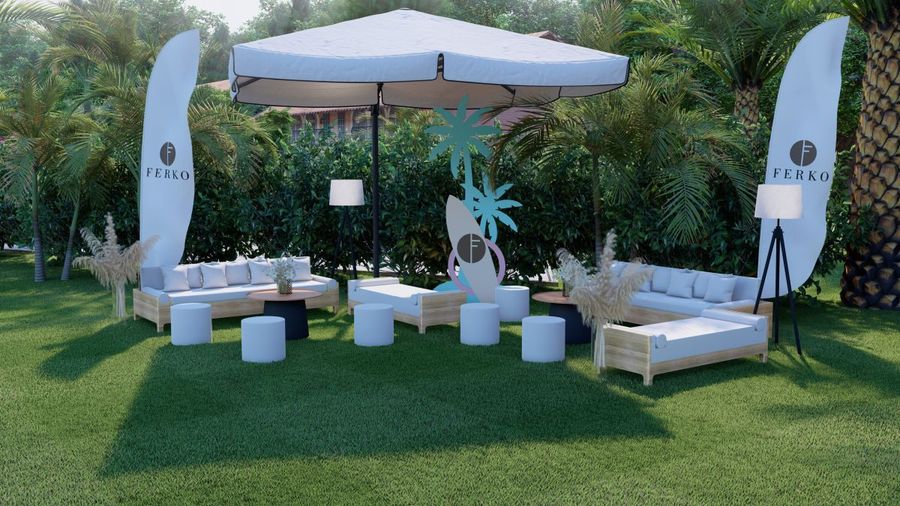 Garden reception layout with shaded lounge seating by the sea — BACKSTAGE Event design visualisation for a coastal wedding setup
3. The Multi-Day Programme on Turkish Ground
A Turkish venue does not change the programme — it changes what each function can look like. A typical three-day arc maps like this.
Day one: mehndi and welcome
The mehndi afternoon works best in a garden or terrace setting — henna artists flown in or sourced locally, a colour-themed decor build, and a relaxed catering line. Evenings often merge into a welcome dinner; in Istanbul this is where the Bosphorus terrace earns its place, on the coast it is a beach-club takeover.
Day two: haldi and sangeet
Haldi in the morning wants sunlight and washable surroundings — resort lawns handle it gracefully. The sangeet is the production centrepiece: a stage, a proper sound system, choreographed family performances, often a booked artist or DJ flown in from Mumbai or London. This is a genuine show night, and it is where Turkish event production — the same crews that build concert stages and festival productions — makes a visible difference. Section 8 covers the build.
Day three: baraat, pheras and reception
The baraat procession needs a route — resorts can close internal roads for a horse (or vintage car) entrance in a way city venues manage only with planning. The ceremony itself centres on the mandap and the pheras around the fire; your priest travels with you or flies in from India, and open-flame permissions at the venue are a detail to confirm early (most Turkish resorts accommodate it; some historic Istanbul venues restrict it). The evening reception then returns to familiar territory: ballroom or terrace, formal dinner, speeches and a dance floor that runs late.
Sikh, Muslim and mixed programmes
Turkey handles non-Hindu programmes just as readily. An Anand Karaj needs a gurdwara or a consecrated setting arranged with the community; a nikah is straightforward in a majority-Muslim country with imams and halal catering as the default; and mixed-tradition weekends — one family's ceremony Saturday, the other's Sunday — are increasingly the pattern we build for diaspora couples.
4. What an Indian Wedding in Turkey Costs
Real budgets vary enormously with guest count, functions and appetite for production, so treat these as honest planning bands for 2026–27, not quotes. They assume three days, full decor and production, and international-standard five-star venues.
| Guest count | Typical band (EUR, all functions) | What moves the number |
|---|---|---|
| 80–150 (Bodrum/Istanbul style) | €120,000–€250,000 | Venue prestige, artist bookings, yacht events |
| 150–250 (mixed) | €200,000–€400,000 | Room-block scale, decor ambition, flown-in talent |
| 250–400 (Antalya resort style) | €300,000–€600,000+ | Resort buyout level, production scale, guest travel support |
Three notes that make these numbers useful. First, the biggest single lever is the guest count — every head carries catering, seating, transfers and usually a room night. Second, decor and production together commonly run 25–35% of total spend at Indian weddings (well above the share at a European wedding), because the mandap, stage and multiple full decor turnovers are the visual heart of the event. Third, compared with an equivalent programme in Italy or France, families typically report savings of 25–40% — which is precisely the margin that funds the extra function or the headline sangeet artist. Deeper cost mechanics — venue types, seasonal pricing, payment scheduling — are covered in our destination wedding guide.
5. The Legal Side: Symbolic, Civil or Both
Most Indian weddings in Turkey are symbolic: the pheras, Anand Karaj or nikah is conducted in full, and the legal registration happens at home in India, the UK or wherever the couple resides. This is the simplest route — no Turkish paperwork at all — and it is what the majority of our couples choose.
A civil marriage in Turkey is also fully possible for foreign nationals, including two non-residents, through the local marriage office with apostilled documents. If you want the legal act to happen in Turkey — some couples like the certificate to carry the place they married — the process, documents and timelines are laid out step by step in the legal section of the destination wedding guide. Allow several weeks for document preparation and translations, and let your planner book the registrar early for peak Saturdays.
The practical advice: decide symbolic-versus-civil at the very start, because it changes nothing about the celebration but everything about the paperwork calendar.
6. Guest Logistics: E-Visas, Flights and Hotel Blocks
Visas
Indian passport holders can obtain a Turkish e-visa online when they hold a valid visa or residence permit from the US, UK, Ireland or Schengen — which covers a large share of a typical NRI-heavy guest list. Guests without such a document apply through a standard visa process, which is routine but slower: collect passport details early and start the visa track a good two to three months out. UK, US and EU passport holders use the e-visa or visa-free regimes with no friction. Build a guest data sheet — full names, passports, dietary notes — as one of your first planning artefacts; every workstream downstream feeds off it.
Flights and arrival flow
Istanbul's two airports carry direct flights from every Indian metro; Antalya and Bodrum connect via a short domestic hop or seasonal directs from the Gulf and Europe. The arrival experience is worth producing properly: staffed welcome desks, luggage handling, and a transfer schedule that absorbs the inevitable late changes. For 300 guests arriving across 48 hours, this is a genuine operations job — plan it like one.
Hotel blocks
Resorts make this easy — one property, one block, one negotiation, and the wedding takes over its own world for three days. City weddings split guests across two or three hotels by budget tier, which works well if transfers are centrally run. Either way, room-block negotiation and guest accommodation management is a job to hand to the planning team early: rates move with the season, and Antalya's summer inventory sells out months ahead.
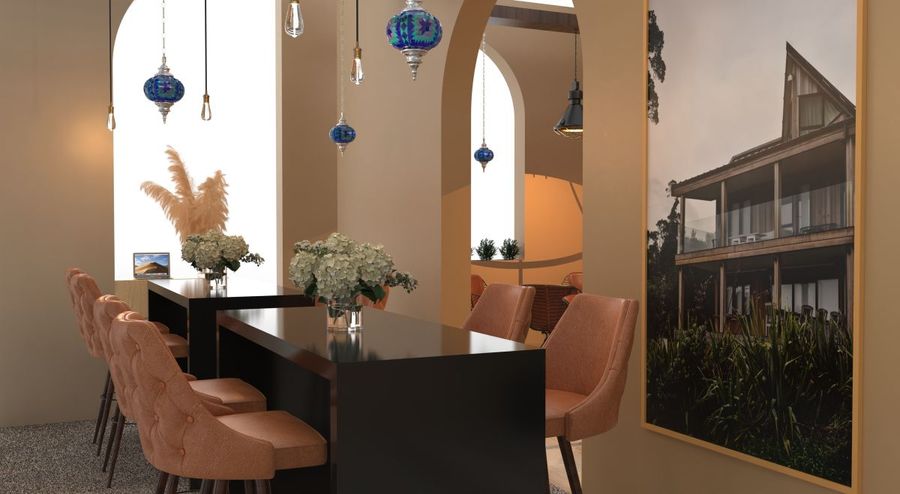 Interior dining space with Turkish lanterns and floral tablescape — BACKSTAGE Event design visualisation for a welcome-dinner setting
7. Food: Getting Indian Catering Right in Turkey
Food is where Indian weddings are won or lost, and it deserves engineering, not hope.
The workable models
Large resorts increasingly host visiting Indian chef teams — flown in from India, Dubai or London — working alongside the house kitchen, which handles infrastructure, sourcing and service while the visiting team owns the menu. For Istanbul weddings, the city's Indian restaurants can scale up for smaller functions, and hybrid menus (Indian mains, Turkish mezze and grills, international stations) genuinely delight mixed guest lists. What does not work is assuming a Turkish kitchen can improvise a wedding-grade Indian menu from recipes — insist on a dedicated Indian culinary lead.
Dietary architecture
Plan vegetarian as a first-class track, not an option — at many weddings it is half the room. Jain requirements (no onion, no garlic, no root vegetables) need the visiting chef team briefed explicitly and a separate prep line. Halal is effectively the default in Turkey, which simplifies Muslim guest requirements. Alcohol is freely served at private events — bar programmes run exactly as they would in Europe.
The tasting trip
Fly in once, four to six months out, and taste everything: the Indian menu, the Turkish additions, the bar list. It is the single most valuable quality-control day in the whole project.
8. Production: Mandap, Sound, Light and the Sangeet Night
This is our home ground, so here is what production-minded planning looks like for an Indian wedding in Turkey.
The mandap is a build, not a prop
A proper mandap is engineered scenery: a structure that carries floral load and lighting, sited for photography angles and — outdoors — calculated for coastal wind. Building it with a local production house costs a fraction of shipping decor internationally, and Turkish fabrication shops working from your designer's renders deliver to a standard that surprises families every season.
The sangeet is a concert
Treat it like one: a stage with proper trussing, a line-array sound system sized for the room or lawn, moving-head lighting programmed for performances, LED screens for the family videos, and a stage manager running the show call. The same supplier pool that services Turkey's festival circuit builds these nights — you can see the scale of build in our Eurasia Blockchain Summit congress production — and noise curfews at outdoor venues are real, so the after-party moves indoors on schedule rather than by argument.
Multiple turnovers are the hidden job
Mehndi decor out, sangeet stage in, ceremony mandap up at dawn, ballroom flipped for the reception — an Indian wedding is three or four full production turnovers in seventy-two hours. That is a crew-scheduling and logistics problem, and it is the clearest argument for a production partner with depth rather than a decorator with ambition.
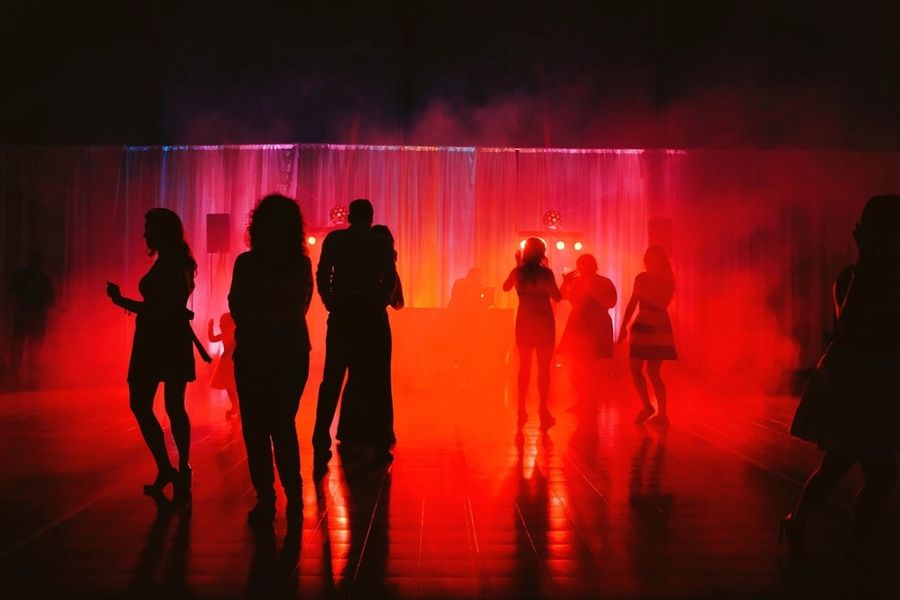 Silhouettes of guests dancing on a floor lit in deep red, with haze in the air
9. A 12-Month Planning Timeline
12–10 months out
Fix the guest-count band and the base (Antalya, Istanbul, Bodrum). Hold venue dates — for July–September, a year ahead is not early. Decide symbolic versus civil. Appoint the local planner/production partner.
9–7 months
Lock the venue contract and room blocks. Book the priest or officiant, headline sangeet talent and any flown-in chef team — the good ones calendar out early. Start the guest data sheet and the visa track for Indian-passport guests.
6–4 months
Design freeze: mandap, stage, decor themes per function. Tasting trip. Send formal invitations with travel guidance. Confirm flight recommendations and transfer plan.
3–2 months
Production drawings signed off; venue technical visits done; running orders drafted per function. Final guest numbers begin to settle; room blocks trued up.
Final month
Seating, show calls, choreography rehearsal schedule, welcome-desk rosters, weather contingency locked. Ship or clear customs on anything travelling — outfits, favours, religious items.
Wedding week
The production team runs a build calendar; the family's only job is to arrive early enough to enjoy it.
10. Working With a Local Planner
You will almost certainly work with an Indian wedding planner or a family production committee — that is how these weddings are run, and it works. What the Indian side cannot replace is the Turkish ground game: venue relationships and contract norms, municipal permissions and noise rules, the supplier pool for stages, sound, light and decor fabrication, licensed transfer fleets, and the two-languages-three-currencies problem of running an international event in Turkey.
That is the partnership we offer at BACKSTAGE Event: full wedding and gala production on the ground — venues, production, catering coordination, guest logistics — working alongside your planner or directly with the family, with our broader wedding services team behind it. We will tell you honestly which venue fits your guest list, what your budget band really buys in Turkey, and where the money is better moved from decor to production or back.
If a Turkish chapter for your wedding is on the table, talk to us — the first conversation costs nothing and usually saves a detour or two.
Frequently Asked Questions
How much does an Indian wedding in Turkey cost?+
As 2026–27 guidance for full three-day programmes: €120–250k at 80–150 guests, €200–400k at 150–250, and €300–600k+ for 250–400-guest Antalya resort weddings. Guest count is the biggest lever; against an Italy or France equivalent, families typically save 25–40%.
Can we hold our Hindu, Sikh or Muslim wedding ceremony in Turkey?+
Yes. Most couples hold the ceremony symbolically — the pheras, Anand Karaj or nikah is conducted in full, with legal registration completed at home. Couples who wish can also marry civilly in Turkey with apostilled documents; both routes are established practice and venues are accustomed to religious ceremonies.
Which is the best place in Turkey for an Indian wedding?+
It depends on guest count: Antalya's Belek–Lara resorts for 200+ guests (capacity, beach, buyouts); Istanbul under 200 for prestige and skyline photographs; Bodrum for an 80–150-guest private-festival feel. All three carry the multi-day Indian programme comfortably.
Do Indian passport holders need a visa for Turkey?+
Yes — but Indian passport holders with a valid US, UK, Irish or Schengen visa or residence permit obtain the e-visa online in minutes, which covers most NRI-heavy guest lists. Guests without such a document should start the standard visa process two to three months ahead.
Is Indian catering available at Turkish wedding venues?+
Yes — the established model is a visiting Indian chef team from India, Dubai or London working alongside the venue kitchen: the visiting team owns the menu, the house provides infrastructure and service. Vegetarian and Jain lines are set up separately; halal is already the default in Turkey.
Subscribe to Our Newsletter
Subscribe to our newsletter for event trends, design insights, and exclusive content.


