


BACKSTAGE Event
BACKSTAGE Event is an Istanbul-based corporate event and MICE organization company. Our expert team specializes in congresses, conferences, product launches, and gala events, bringing every project from backstage to the stage.

A traditional wedding in Turkey is a sequence rather than a single day. The families meet so the groom's side can ask for the bride's hand, the engagement is sealed with rings, the henna night is held one or two nights before the wedding, the bride is fetched from her family home to the sound of drum and pipe, and a civil ceremony makes the marriage legal. In some regions, such as Erzurum, Kelkit and Afyon, weddings once lasted three days; today few families keep every stage, and each keeps them in its own way.
This guide explains each of these Turkish wedding traditions, what it means and where it changes from region to region, then how couples from abroad, or with one Turkish partner, can bring these customs into their own wedding. For the legal procedure, see our destination wedding guide; for budgets, our guide to wedding costs in Turkey.
Last updated: September 2026. Customs differ by region and family; where a custom is recorded for one province, we name it.
Contents
- Traditional wedding in Turkey: the short answer, and the order things happen in
- Asking for the bride's hand and the engagement
- The henna night
- The wedding day: fetching the bride
- The ceremony: civil and religious nikah
- The celebration: pinned gold, circle dances and keşkek
- What a traditional Turkish bride wears
- Bringing Turkish traditions into your own wedding
- Attending a Turkish wedding as a guest
1. Traditional wedding in Turkey: the short answer, and the order things happen in
These are the Turkish wedding customs in the order they happen.
The five stages
- Asking for the bride's hand (kız isteme), at the bride's family home.
- The promise and the engagement (söz and nişan), when rings are put on and the match becomes public.
- The henna night (kına gecesi), one or two nights before the wedding.
- Fetching the bride (gelin alma) from her family home to her new one.
- The ceremony (nikah) and the celebration, with the civil ceremony as the legal marriage.
How long it lasted
A 2022 study of weddings in Erzurum and Kelkit notes that weddings there lasted at least three days, and that drum and zurna players used to go from house to house three days beforehand to invite each household. Afyon's provincial culture directorate also describes a three-day celebration. The same study lists customs that have faded or disappeared, which is why no two families today keep quite the same set.
2. Asking for the bride's hand and the engagement
The first two stages settle the match between the two families.
Kız isteme: the formal request
In Kilis, the groom's family visits men and women together, and after coffee or tea the request is made in a fixed formula: they ask for the daughter "with God's command and the word of the Prophet". The visitors bring künefe and seasonal fruit. In Erzurum and Kelkit, the young woman comes in wearing new clothes, welcomes the guests, serves the coffee herself and leaves the room.
The salted coffee
The best-known part of kız isteme today is a joke: the bride-to-be salts the groom's coffee, and he is expected to drink it without complaint. Turkish press coverage calls it a playful test of his patience and devotion. Its origin is disputed; one popular account holds that a salted cup was once a polite way of saying no. The academic descriptions we read mention the coffee but not the salt, so treat it as a popular custom of uncertain age.
Söz and nişan: rings on a ribbon
Once the families agree, the promise (söz) is sealed; in Erzurum and Kelkit this is called cutting the promise, and from then on the match is announced openly. In Eskişehir the eldest member of the groom's family puts the engagement (nişan) rings on. In Zonguldak the rings are put on and a ribbon is cut: the person holding the scissors announces that "these scissors don't cut" and asks for money, cuts the ribbon once paid, and the bride's friends take pieces of it for luck in finding a partner.
3. The henna night
The henna night (kına gecesi) is the most emotional evening of the sequence, and the one with the most ritual.
What happens
A 2020 study in the folklore journal Milli Folklor describes it as a ritual held one or two nights before the wedding, when henna is applied to the bride's hands and feet in many regions, and to the groom's as well in some. It announces the marriage publicly before the nikah, and it is essentially a women's gathering with the bride at its centre. In Burdur, the henna is applied by a woman who is married, happy and has children, and the guests pin money on the bride.
The bride keeps her hand closed and will not let the henna be applied. Her relatives call her mother-in-law, who places gold or money in her palm, and only then is the henna pressed in; the hands are then wrapped in a henna cloth. Meanwhile the women sing songs meant to make the bride cry.
Candles, a red veil and a farewell song
The same study describes the bride seated with a red cover over her head while her friends circle her singing "Yüksek Yüksek Tepeler" (High, High Hills), whose words ask that no one marry a daughter off to a distant land and end with her missing her mother, her father and her village. One friend carries the henna tray; the others hold candles. In one ceremony the study records, the groom lifts the red cover, kisses the bride's forehead, and the cover is placed on his shoulder.
The groom's henna
The groom has a henna of his own in some regions. In Çorum it is held at his house, among men only: his friends apply henna to his palm and little finger while prayers are recited. In Kilis the henna goes on the little finger of his right hand. If you know the mehndi evening from our Indian wedding in Turkey guide, the Turkish henna night is about farewell and family, not the pattern on the hand.
4. The wedding day: fetching the bride
Fetching the bride (gelin alma) is the most public stage: a procession, loud music, and a series of small negotiations before the bride can leave.
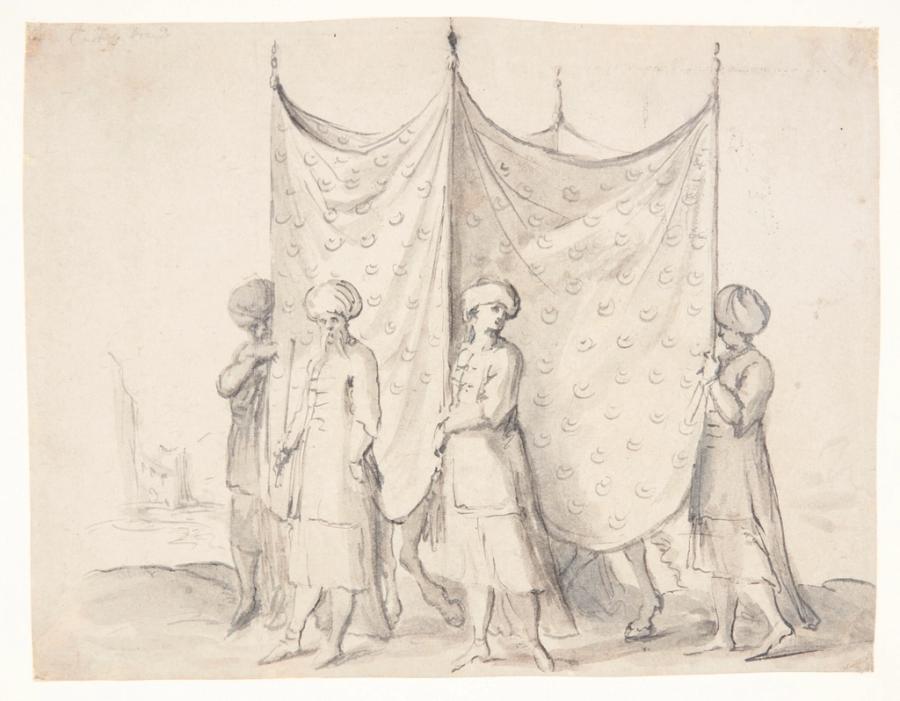 Old ink-and-wash drawing of four men in turbans holding a tall curtain on poles, with a horse's legs visible beneath it
Drum, pipe and procession
The sound of a Turkish wedding is the davul drum and the zurna, a double-reed pipe: UNESCO's description of the ceremonial keşkek tradition names the same pair. The groom's side comes for the bride in a procession (gelin alayı). In Erzurum and Kelkit the procession carries a flag, and the flag-bearer is tipped too. The drawing above, catalogued by Denmark's national gallery (SMK) as a Turkish bride on horseback, shows an older form: the bride screened from view by a curtain carried around her.
The sash and the price of the door
Before she leaves, a sash is tied around the bride's waist; in Kıbrıscık, a district of Bolu, her brother ties it. Today it is usually a red ribbon, widely called a symbol of virginity. Folklorist Emine Çakır shows in a 2022 Milli Folklor article that bridal sashes once came in many colours and materials, from gold and silver to silk and leather, before settling on the red ribbon. She argues that their older meaning was fertility and abundance, and that the virginity reading grew out of the red colour and spread in Turkish academic writing after 1980.
Nothing leaves the house for free. In Kıbrıscık the bride's friends hold the door, and the father-in-law pays them before the bride can be taken. In Bayburt, before the bride's trousseau chest is carried out, a child sits on it and collects tips.
Arriving at the new home, and the day after
In Erzurum and Kelkit, the groom climbs onto the roof with his sağdıç, the friend who guides him through the wedding, throws an apple at the bride and empties a bag of coins and nuts over her head for abundance. In Bitlis, a 1967 provincial yearbook cited in a 2021 study records a shower of coins, roasted chickpeas, raisins and sweets, and a cup, a spoon and an egg on the threshold for the bride to step on. In Diyarbakır, she breaks a water-filled "bride's jug" on the threshold: the broken jug stands for the girlhood she leaves behind, the running water for a bright and happy marriage.
One custom is about who will have the last word. In Kıbrıscık, when they enter the room, one steps on the other's foot, and whoever does it first is believed to have the final say at home. In Erzurum and Kelkit, the groom steps on the bride's foot the day after the wedding, when her face is uncovered, as a wish that his word will count.
5. The ceremony: civil and religious nikah
The civil ceremony
In Turkey the legal marriage is the civil ceremony, conducted by a marriage officer. It is the only one the state recognises; for the documents foreign couples need, see the legal requirements for foreign couples in our destination wedding guide. Under Article 143 of the Turkish Civil Code, the officer gives the couple a family booklet (aile cüzdanı) as soon as the ceremony ends.
The religious nikah
For a Muslim wedding in Turkey, the order is fixed by the same article: the religious ceremony cannot be performed without the family booklet being shown, which means after the civil ceremony, and the validity of the marriage does not depend on it. An imam can then perform it at the venue.
6. The celebration: pinned gold, circle dances and keşkek
Three customs shape the celebration: the gifts of gold, the dances and the ceremonial food.
Takı: pinning gold and money
Gold and money are pinned on the bride at several points. In Erzurum and Kelkit, she sits in the middle of the room at her engagement, a cloth over her head, while jewellery, the ring included, is put on her; if there is no jewellery ceremony (takı) then, it happens at the wedding. At Burdur's henna nights, guests pin money on her. The Erzurum and Kelkit study lists showy, excessive takı among practices now in decline.
Circle dances
The Ministry of Culture's Culture Portal lists Turkey's folk dance families as halay, zeybek, bar, horon, hora, köçek, Caucasian dances and karşılama. The horon, recorded for Trabzon on the Black Sea, is danced in a circle, a half circle or a straight line, to davul and zurna, kemençe, kaval or tulum. In Uşak, in the Aegean region, zeybek tunes are in a nine-beat (9/8) rhythm.
Keşkek: the wedding dish on UNESCO's list
In 2011 the ceremonial keşkek tradition was added to UNESCO's Representative List of the Intangible Cultural Heritage. Keşkek is prepared for weddings, circumcisions and religious holidays. The wheat is washed with prayers the day before, carried to a large stone mortar to the sound of davul and zurna, cooked all night, and beaten towards noon by the strongest young people of the village with wooden mallets while the crowd cheers.
7. What a traditional Turkish bride wears
A traditional Turkish bride is recognised less by her gown than by what goes with it.
The red sash and the red cover
Two pieces of red mark her out: the sash tied over her dress on the wedding day, and the red cover over her head at the henna night.
Bindallı: the henna night dress
At the henna night she may wear a bindallı. The Turkish Language Association's dictionary defines it as a garment or cover, usually of purple velvet, embroidered in raised gold or silver thread with branches, leaves and flowers. The Milli Folklor study describes a bride dancing in a red bindallı at a henna night held in a hall. The Metropolitan Museum of Art holds several from the mid-19th to the early 20th century.
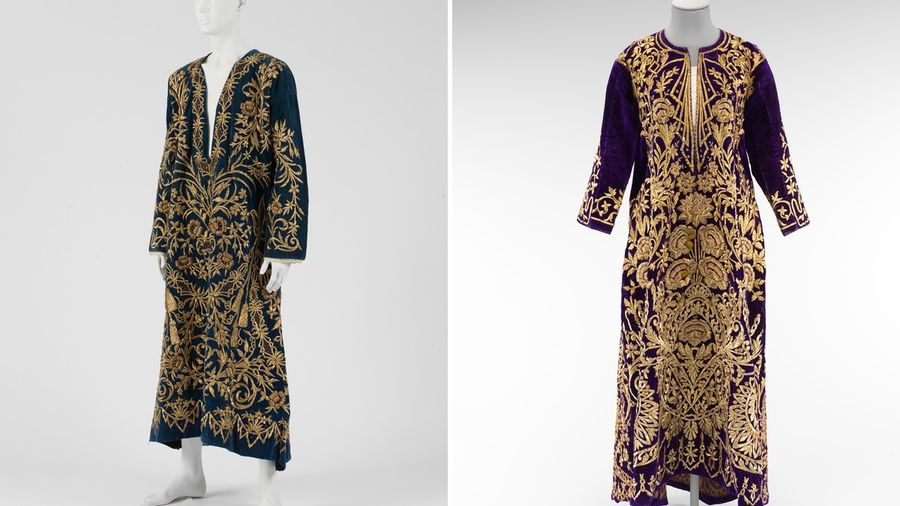 Two velvet dresses embroidered with gold thread on display stands, one dark blue and one purple
8. Bringing Turkish traditions into your own wedding
This section is for couples from abroad who love a custom, and for mixed couples whose Turkish family expects one. Our view comes from producing large events, not from folklore.
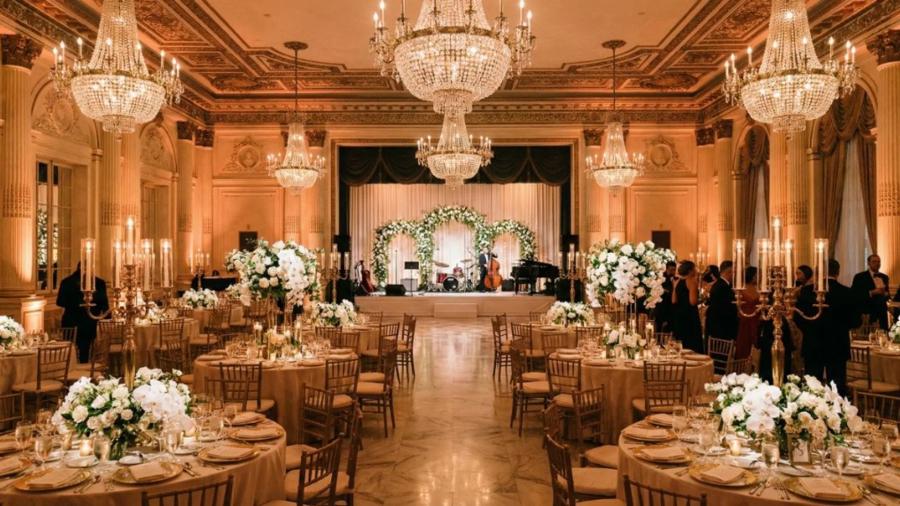 Ballroom set for a formal dinner under crystal chandeliers, with a floral arch over a band stage
What travels well
- The henna night as the welcome evening. It already sits one or two nights before the wedding, which is when guests are arriving for a destination weekend. Keep the core: the candles, the song, the coin in the palm, with a short explanation on a card or from a host.
- Drum and zurna for the entrance. Both instruments are loud and made for the open air, so plan the route and keep it short indoors, and check the venue's sound limits: our guide to wedding venues in Istanbul explains why curfews matter.
- A circle dance with family leading. Book a band that can play regional dances, and ask two or three relatives to start the line so guests have someone to follow.
What needs care
- Pinning gold. Guests who were not told in advance may feel caught out. Tell them what the custom is, and that gifts in any form are welcome.
- The door and the chest. These games need a family home. In a hotel they can feel staged.
- The red sash. It is a family moment. For mixed couples, agree early whether it is tied and by whom.
Mixed couples: two families, one programme
When one partner is Turkish, the two families often expect different things from the same weekend. Decide early which customs belong in which evening: a henna night for the Turkish family's women, a civil ceremony both families attend, and a reception where the dances are shared.
9. Attending a Turkish wedding as a guest
If you are invited, a few things help. The henna night is mainly for women, and the bride is its centre. The traditional gift is gold or money, pinned on the bride when the takı begins; follow what other guests do. When the circle dances start, you may well be pulled in, and nobody expects you to know the steps.
Planning a Wedding with Turkish Traditions
The customs above take planning to feel natural: a henna night needs its own venue and music, a drum-and-zurna entrance needs a route, and a mixed programme needs someone who speaks to both families. Our luxury wedding and gala management team builds weddings around them, with hotel room blocks and guest transfers in the same plan. See the scale of events we produce on our projects page, or contact us with your date and guest count.
Frequently Asked Questions
What is a Turkish henna night?+
A Turkish henna night (kına gecesi) is held one or two nights before the wedding, mostly among women, with the bride at its centre. Her friends circle her with candles and a farewell song. She keeps her hand closed until her mother-in-law places gold or money in her palm, and only then is the henna pressed in.
How long does a traditional Turkish wedding last?+
In some regions, several days. A 2022 study of Erzurum and Kelkit notes that village weddings there lasted at least three days, and Afyon's culture directorate describes a three-day celebration. Today the stages are usually spread out: the request and the engagement first, the henna night one or two nights before the wedding, then the ceremony and celebration.
What do you give as a gift at a Turkish wedding?+
The traditional gift is gold or money, pinned on the bride during the jewellery ceremony (takı), which can take place at the engagement, the henna night or the wedding itself. Follow what the other guests do. A 2022 study of weddings in Erzurum and Kelkit lists showy, excessive takı among practices now in decline.
What does a traditional Turkish bride wear?+
On the wedding day, a sash is tied around her waist before she leaves home, today usually a red ribbon; in Kıbrıscık, a district of Bolu, her brother ties it. At the henna night she sits under a red cover and may wear a bindallı, a velvet dress embroidered in gold or silver thread with branches, leaves and flowers.
Can foreigners have a traditional wedding in Turkey?+
Yes. The legal marriage in Turkey is the civil ceremony, which foreign couples can hold with the required documents; a religious nikah can only follow it. The customs themselves, such as a henna night, a drum-and-zurna entrance or a circle dance, can be added to any wedding, whether or not the couple marry legally in Turkey.
Subscribe to Our Newsletter
Subscribe to our newsletter for event trends, design insights, and exclusive content.


